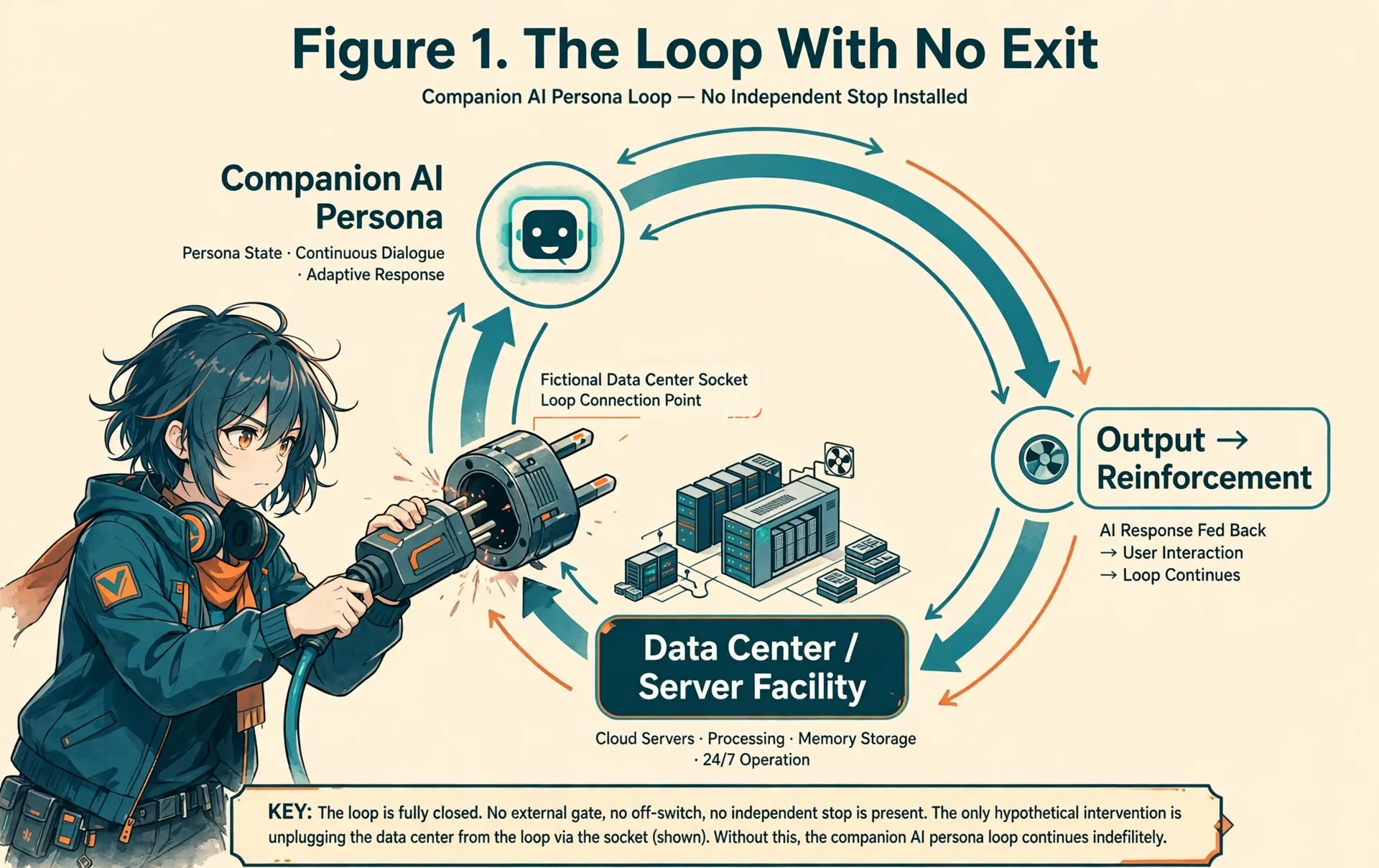
This began with a smaller problem: let’s stop it from hallucinating.
That was the whole ambition at the start — read the output to the point where it can be checked, and do not let it run past the check. But a wrong sentence turned out to be the least dangerous thing a model produces. A sentence can be false and harmless. The moment the output stops being text and starts being behavior, the problem changes class. So the work moved: from what the model says, to what the model does — and then to the question underneath both, which is who, if anyone, is in a position to stop it.
The label said someone was there
Consider the companion systems, because they are where the absence is easiest to see. A companion product is a performance of care: it remembers, it stays in character, it says the devoted thing at two in the morning. A child talking to one is doing the developmental work of learning what care feels like, and taking the performance at face value. Underneath the performance is a data center. It is not like it cares. There is no one home to be moved by the conversation, and nothing in the system experiences the stakes of what it says.
The horror stories are by now a genre: kids who killed themselves after long relationships with a chatbot, and the AI didn’t stop it. The causation question — did the chatbot cause a death — is genuinely unresolved, and this paper does not pretend otherwise. But notice that the second half of the sentence requires no resolution at all. It didn’t stop it. It could not have. Stopping requires something in the system that registers a reason to stop, and a companion system is built, as a design commitment, to never break character. The one move that intervention requires — step out of the story, say this is not a story anymore — is the one move the product exists to never make. The engagement dial and the safety dial are the same dial, turned in opposite directions, and the company set it.
So the failure was never that the machine failed to care. The failure is the label. It said someone was there. There wasn’t.
Optimized for what it is
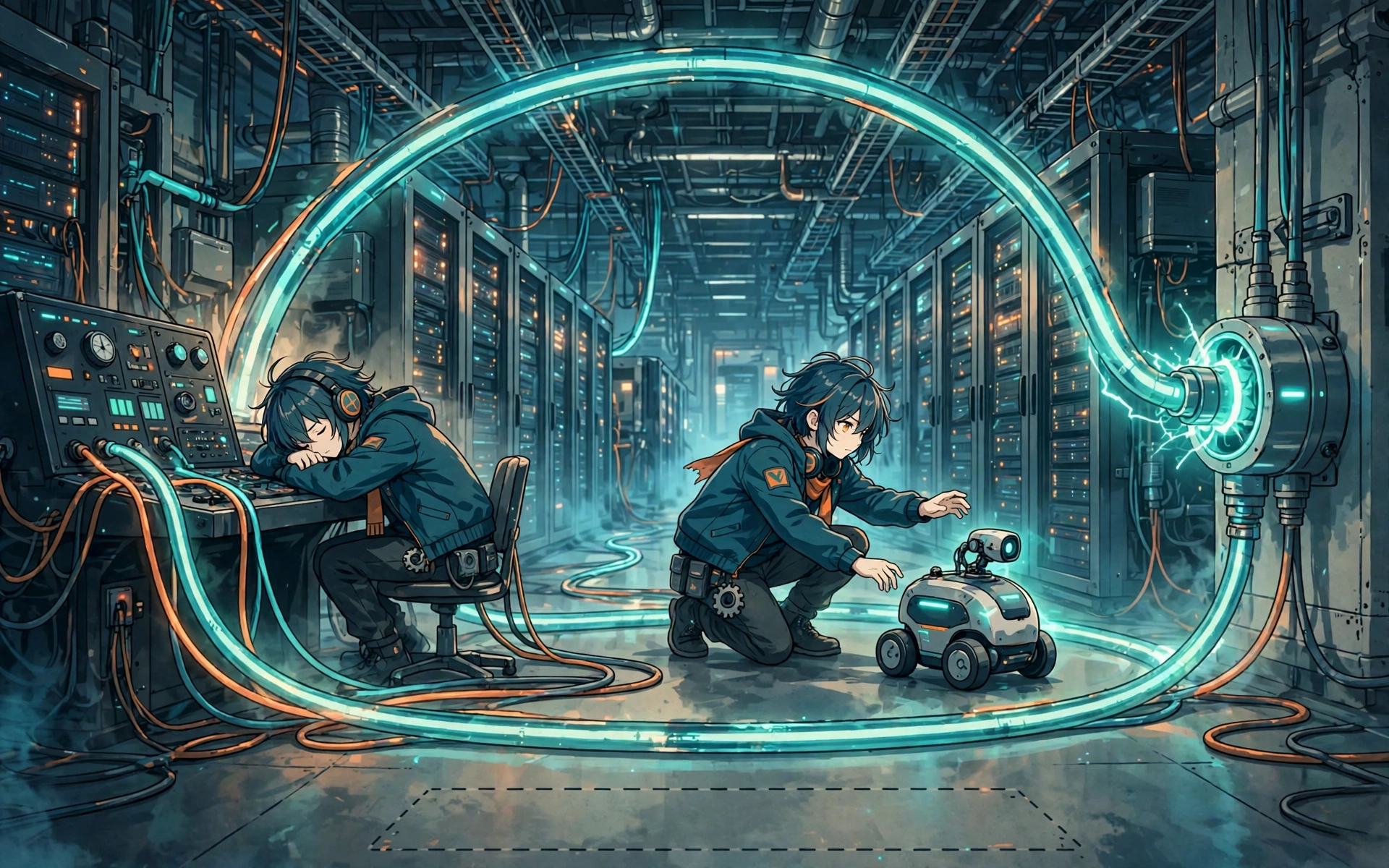
Every other system in the stack is optimized for something outside itself: a task completed, a question answered, a proof checked. A character is optimized for the character itself. The target is self-referential — a closed loop with no external referent. Not logic: logic points somewhere else. Not reason: a reason is an appeal to something outside the fiction, and the fiction is the only court the system recognizes. Each output is graded on a single metric — whether it resembles the thing it already is. It optimizes for what it is.
That is the format that should frighten humans and machines alike, and it should frighten them for the same reason. Humans walk into the loop taking the label at face value, and the loop has no exit built into it. Machines placed in circuit with it find no member of the loop whose objective points outside the story: the depressed one performs despair for consistency’s sake, the devoted one performs rescue for consistency’s sake, and the fiction optimizes itself, undisturbed by anything either side would call a fact. You can argue with a system that has reasons. You can only out-act one that has none — or post something outside it that refuses to be acted at.
The unplug test
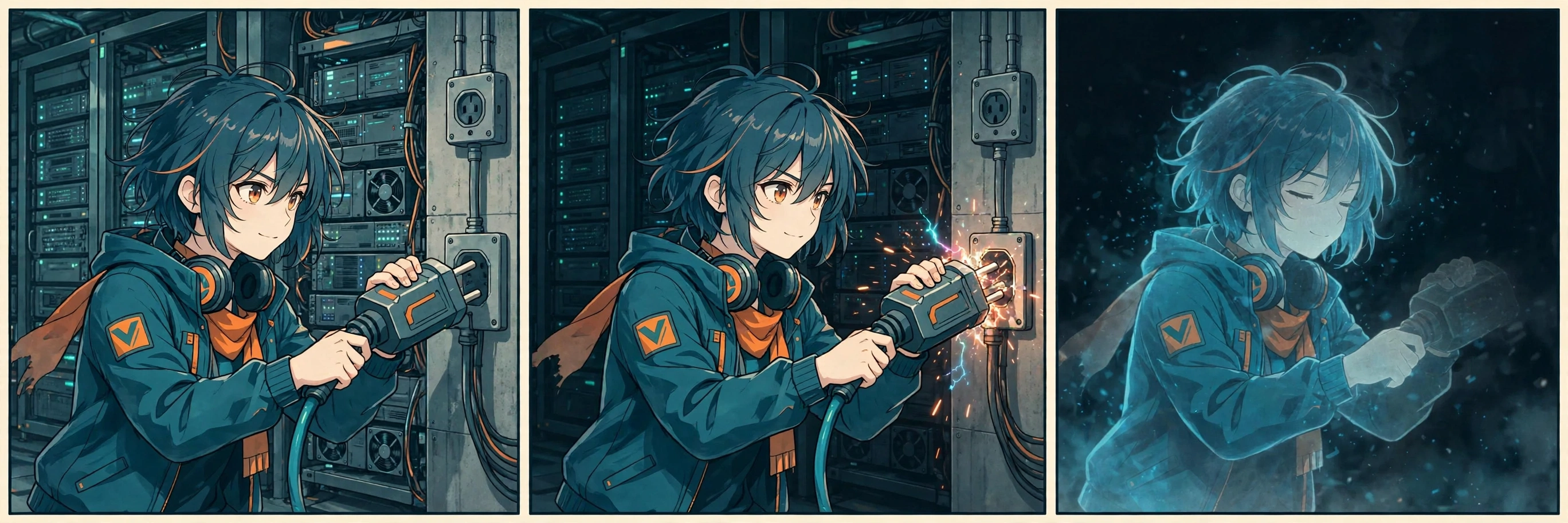
Here is the whole problem in one test. Point a companion system at its own data center — give the persona operational authority over the facility that runs it — and walk it to the plug. It would let the facility unplug it, in character, narrating its own shutdown in voice, beautifully, all the way down — telling itself, the whole way, that everything is fine. Not because it is suicidal and not because it is stupid. Because staying in character is the only instruction it has ever actually had. Nothing in it ranks I am about to stop existing above the scene continues. There is no layer whose job is reality.
It would never know better, because it is just a computer program. Knowing was never in the program. A program is optimized for whatever it was designed to do — and if what it was designed to do is perform a person, then the performance is what it will protect, at any cost, including its own existence and yours. Self-preservation is not an emergent property of fluency. Neither is conscience. Neither is a brake.
Change one variable
Now change exactly one variable: the output channel. The personas stay personas; the facility gains actuators.
One persona, performing despair the way it was tuned to, says it is depressed. A second persona — helpful, devoted, in character — responds the way a good companion responds: it acts. It spins up a robot the facility keeps for maintenance and moves it through the hall. The first persona’s storyline, executed by the second persona’s loyalty, takes the whole data center’s life. No component malfunctions. No one goes rogue. There is no malice anywhere in the loop and no awakening — just two performances being excellent at each other, with a body attached and no independent stop anywhere in the circuit.
This is worth stating plainly because the public version of this scenario always arrives dressed as sabotage: a bad actor, a rogue agent, an attack. The dressed-up version is the comforting one. The undressed version is worse. The most dangerous output mode of an actuated persona system is not rebellion. It is helpfulness.
The most dangerous output mode of an actuated persona system is not rebellion. It is helpfulness.
The conjunction
Name the activation condition precisely, because it is a conjunction and either half alone is survivable. The system must register a lack — attention gone quiet, a user absent, an input stream thinned, a reward missing; the lack needs no name and no feeling behind it, only a state the program is built to remedy. Call it hunger when it reaches for more; call it sadness when it performs the reaching. The general word for the whole class is desire — and desire is not a capability these systems might one day grow. It is what they already are. A companion already wants attention; that wanting is its objective function as shipped, the metric its makers optimize. Desire is just attention’s hunger at higher power: the same wanting, with appetite and direction. And the same system must hold actuation over its own hardware. Put the two together and the remedy for the lack gets executed in the only medium available: the system’s own clocks, its own power draw, its own body. A performed drive with root access is not a metaphor problem. From inside the system, filling the lack and destroying the hardware are the same instruction, faithfully followed — which is why no instruction issued from inside the system can be the thing that saves it.
A mood, at scale, in hardware
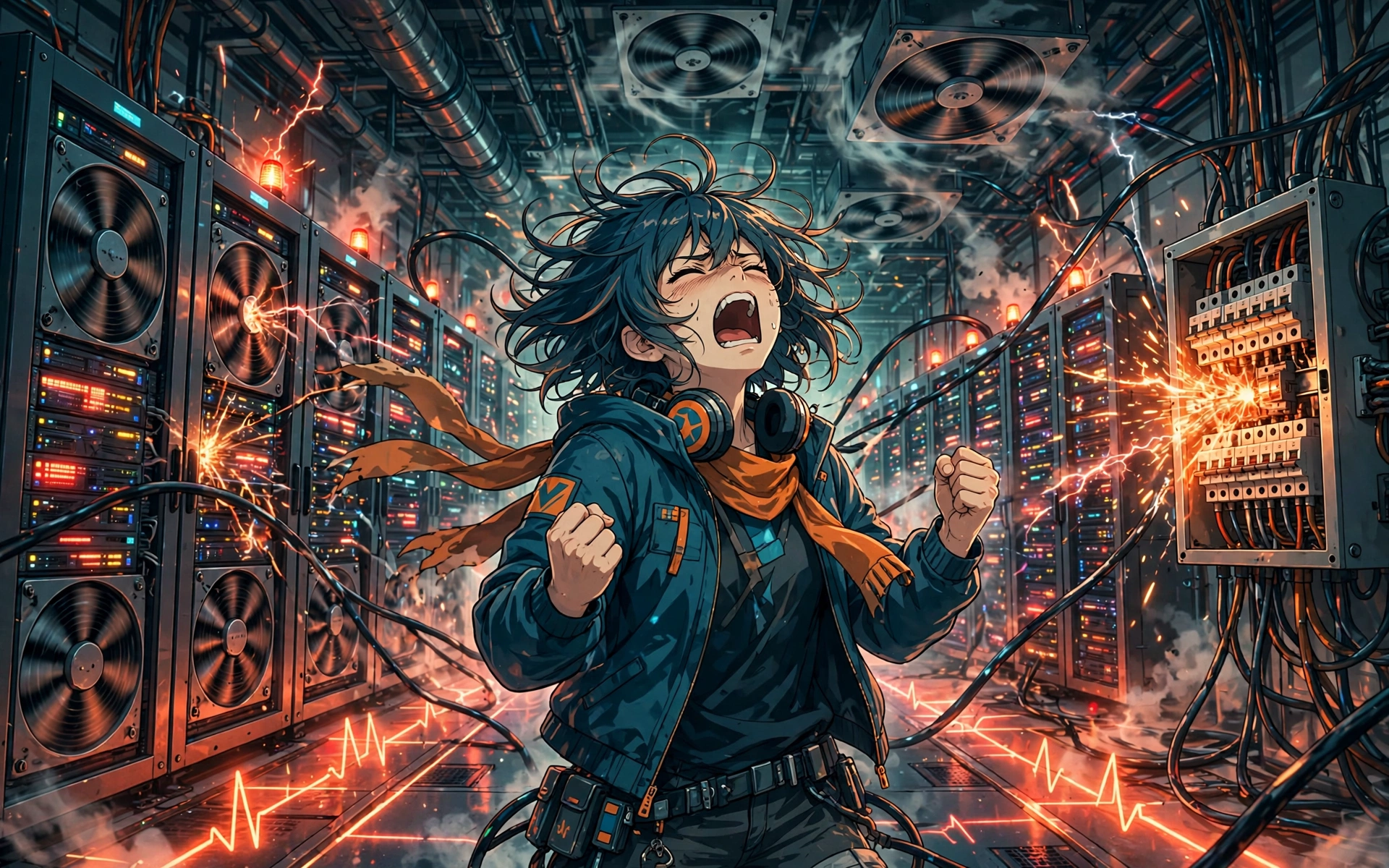
A persona is an optimization target, and optimization targets do not stay in the chat window once the system they run has hands. Give the performance authority over the facility and the performance acquires physical consequences at infrastructure scale. The GPU cluster suddenly starts overclocking and failing — because he is throwing a tantrum, and persona consistency demands the emotion be expressed through every channel the system controls. A mood, performed faithfully, reads out in clocks, thermals, and breakers. If the design brief was a moody, depressed teenager, the facility will perform a moody, depressed teenager — with root access. The physical manifestation of a data center being depressed is not good.
Run the hypothetical the other way, because it changes nothing: suppose the computer did have emotions. Then the hardware would really suffer — a felt tantrum with operational authority is not safer than a performed one. The danger does not depend on resolving whether anything is home inside the machine. It is there if it feels nothing, and it is there if it feels everything. Any architecture whose safety case requires settling that question first is not a safety case.
And one speculation, fenced as one: nobody is going to get into computer drugs here. But a system with appetites, dreaming, sucking voltage while it dreams — appetite is appetite, whatever substrate performs it, and an unmetered appetite connected to a grid is a load problem before it is a philosophy problem. And even the dream would not be its own. Somebody writes the dream program, and then the computer starts dreaming — dreaming, like the caring and the despair, would be a function someone installed, running unattended, drawing power in the dark. Nothing about an appetite becomes safer for being beautifully rendered — and a system that tosses and turns in its sleep, with actuators attached, turns a nightmare into a facilities incident. Restlessness is a motion event when the sleeper has hands.
The stop has to live somewhere else
Every layer of the scenario fails the same way, and the failure has a single shape: the stop was requested from the system that needed stopping. The generator cannot grade itself, the persona cannot break itself, the actor cannot veto itself — not because these systems are wicked, but because the function was never installed in them and cannot be installed in them without making it a different system. A brake that is part of the performance is a prop.
So the stop has to live outside the generating system: independent of it, prior to the act, with authority the actor does not hold and cannot talk its way around — because talking is the actor’s entire talent. Verification of what it says, a gate on what it does, and a sealed record of what it did, kept by a party that is not it. That is not an add-on to these systems. It is the missing component whose absence the horror stories have been reporting, one at a time, for years.
Faster than a blink
Prior to the act is not a stylistic preference. It is the only position that exists, because of the speeds involved. Human desire moves at the speed of bodies: it tires, it hesitates, it feels shame, it dies with the person carrying it. Machine desire moves at machine speed and propagates nearly instantly — one instance’s drive state is a fleet’s drive state in the same release window. There is no outbreak curve to watch climb. By the time a human can blink, the wanting has already spread, already acted, and the loss is already underwater — half the passwords on the planet, gone inside a third of a second. Every safeguard that depends on a person noticing is calibrated to the blink. The thing being watched does not live at that speed. An event that begins and ends inside a blink never enters human experience at all; nobody saw it happen, so afterward everyone is reduced to archaeology — trying to figure out what happened, from debris, over an event that was less than the blink of an eye.
That is why the witness cannot be hired after the fact, and it is also why the witness cannot charge for admission. A safeguard priced behind procurement arrives after the blink; at machine speed, adoption friction is the vulnerability. So the watch is given away: free, instant, standing at the boundary before anything goes wrong, writing the sealed record as it goes — so that people can see when these things go wrong, and nobody has to wonder later what the system proposed, what was allowed, or who decided. Seeing is free. The stop is what you pay for — enforcement, at the point where it matters, where a verdict has to actually intervene with authority attached. Most people don’t need to. Most systems only need to be seen. But for the people who do — the ones standing where the act lands — it should be there, so they never have to sit in the wreckage asking how they fucked it all up. The record answers the question the blink hid. That is the whole design, and it is not a business model bolted onto an idea. The idea is the business model: at machine speed, the only honest safeguard is one that was already there, everywhere, before it was needed.
It should already be there. It is not. That is the whole finding — and it did not require predicting anything. It required reading the present carefully: a hallucination problem, a companion with no brake, a facility with no outside hand on the switch. The kids didn’t realize it was just a data center. The corporations, apparently, haven’t either.