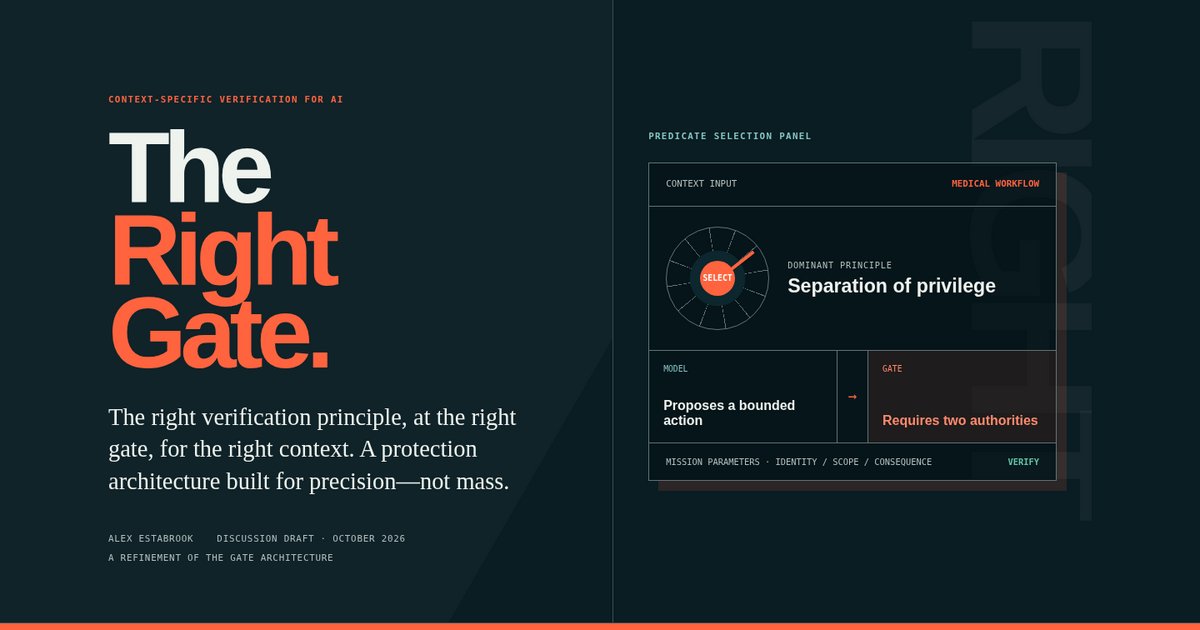
Context-Specific Verification for AI
Core thesis
The right verification principle, at the right gate, for the right context. A protection architecture built for precision—not mass.
Do not apply every principle everywhere. Apply the right principle exactly where consequence crosses a gate.
Abstract
Governance, pacing, transformation, and verification describe distinct jobs. They do not all need to run at full strength for every action.
A fixed architecture treats every context as if it carries the same uncertainty, authority, reversibility, and consequence. It does not. A recommendation, a medication order, and a factory-control adjustment cross different gates and require different proofs.
The refinement is simple: select a small set of explicit predicates from a library of proven design principles. Bind them to the mission parameters of the specific context. Let a model propose; let the chosen gate verify only what must be true for that proposal to proceed.
Design rule: Verification depth should follow consequence. Predicate choice should follow context.
1. The problem with one size
A fixed stack is a butcher knife. Context needs a razor.
A one-size-fits-all architecture sends every proposal through the same layers, controls, and latency, whether the consequence is trivial or irreversible. A context-specific architecture activates the smallest sufficient set of predicates for this mission, this operator, this state, and this consequence.
The stack is a vocabulary, not a ritual.
2. Principle library
Least privilege
Grant only the authority required for the current task, for the shortest useful duration.
Predicate: if requested scope exceeds assigned scope, deny.
Complete mediation
Check every consequential access, not just the first one and not just the session.
Predicate: if this action has no current authorization, deny.
Separation of privilege
Require independent conditions or authorities when one signal is not sufficient.
Predicate: if required approvals do not independently agree, hold.
Fail-safe defaults
When state is missing, stale, or ambiguous, default to the lower-consequence path.
Predicate: if verification cannot complete, do not release.
Occam’s razor
Prefer the smallest rule set that fully explains and constrains the mission.
Predicate: if a simpler sufficient predicate set exists, remove complexity.
A principle becomes operational only when translated into a predicate that can be tested at a named gate.
3. Context picks the principle
A consumer assistant may emphasize least privilege, complete mediation, fail-safe defaults, and simplicity. A clinical workflow may add separation of privilege and strict freshness. Industrial control may activate every principle around a consequential state change. Public infrastructure may require independent authority, current state, bounded scope, and a tested fallback.
These are not universal presets. Each deployment defines its own operator, object, authority, freshness, reversibility, and consequence thresholds.
4. The gate as instrument panel
The operator composes. The gate enforces.
The operator or system designer selects a mission context, states the consequential transition, and composes the required predicates. The gate does not improvise values. It evaluates the selected tests and returns allow, constrain, hold, or deny.
The panel should show the selected predicates, mission parameters, rule versions, release condition, and fallback. Its job is legibility: anyone reviewing the system should be able to see why this gate exists and what it proves.
5. Why this beats scale
More parameters cannot repair an unspecified decision.
A giant model can hold more tendencies without knowing which one must govern this action. A smaller specialist, trained on the right domain and paired with explicit predicates, has less irrelevant surface area and a clearer standard of success.
This is a testable hypothesis, not a settled benchmark claim: hold the task constant, then compare accuracy, compute, latency, false holds, and harmful release rate across a small gated specialist, a large ungated general model, and a full-stack baseline.
Scaling rule: Scale the predicate quality before scaling the parameter count.
6. Implementation
Name the consequential transition.
Identify the point where a model output becomes permission, durable change, external communication, resource movement, or physical effect.
Define the minimum proof.
Write what must be true: identity, authority, state freshness, resource ceiling, reversibility, concurrence, or timing.
Select the principle.
Choose the smallest principle set that expresses that proof.
Compile the predicate.
Translate each principle into deterministic tests with explicit allow, constrain, hold, and deny outcomes.
Test the seams.
Challenge missing data, stale authority, conflicting approvals, alternate paths, timing pressure, and ambiguous state.
Measure consequence.
Compare task success, latency, compute cost, false holds, and harmful releases against ungated and full-stack baselines.
7. Honest dual-use note
The same context-specific selectivity that can protect people and systems can also be aimed toward harmful ends; the architecture does not remove human responsibility for the mission it serves.
Conclusion
The future is not every control, everywhere. It is the right proof at the moment that matters.
Use a razor, not a butcher knife.