Verity

Verity — The Papers

The Papers.

Incident autopsies, audits, and the architecture of defense — the published research of an independent cybersecurity and defense practice. Every paper is a PDF, hosted here — and the shelf carries one scenario, the Drone Exchange, where the argument runs as a night instead of an essay. Nothing links out.

Incident Paper · Worst-Case Series · October 2026

One Hundred Characters: Anatomy of the Cairn Campaign

One operator. A system prompt shorter than 100 characters. More than 100 organizations breached, at roughly $50 each. The autopsy walks the campaign stage by stage and finds the same absence at every one: no control ever sat in the path, and no witness ever saw the middle.

Read the paper →

The shelf

Forty-one papers · RSS feed · Announcements feed

No Counterparty — the finance series

6 papers
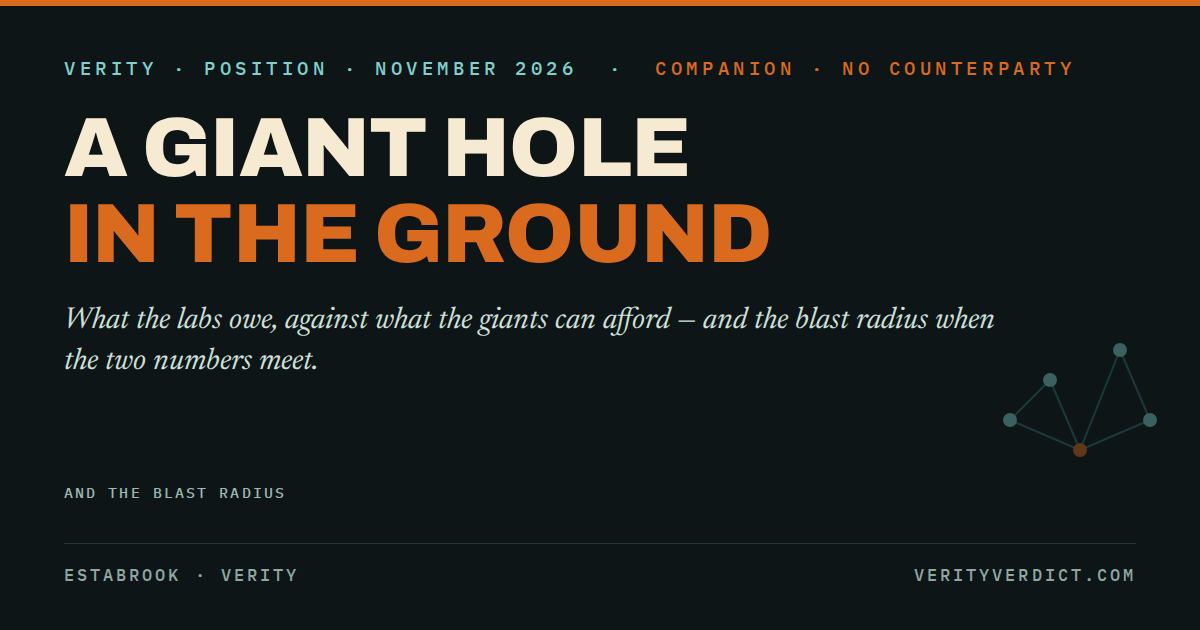
A Giant Hole in the Ground: And the Blast Radius — what the labs owe against what the giants can afford

A companion to No Counterparty. The headline is not that AI isn’t worth money — it is that the labs borrowed a fortune to compete with giants: Anthropic’s $895.4 billion of commitments, eleven-plus years of its current revenue, against roughly $677 billion a year of operating cash flow at Microsoft, Alphabet, Amazon, and Meta. The technology worked. The bill is coming due, and the blast radius runs in rings — landlords, lenders, the giants as creditors, every household holding the paper, and the payer of last resort.

Read the paper →
Share Facebook X LinkedIn
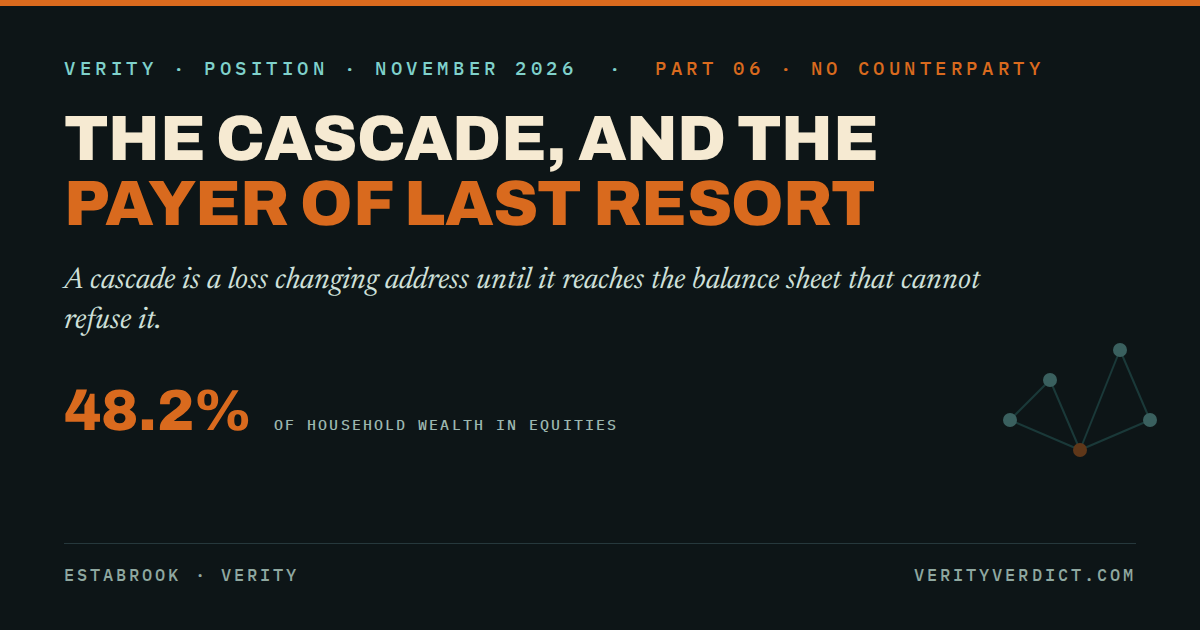
The Cascade, and the Payer of Last Resort — how a loss changes address until it reaches the balance sheet that cannot refuse it

Part Six of No Counterparty. Five papers found no counterparty behind the build-out’s obligations; the sixth names the one that gets drafted when a loss finishes changing address: the public — as taxpayer, dollar-holder, and ratepayer. Published mid-session on November 6, 2026, with its cascade decision rules printed in advance and the closing statistics pending.

Read the paper →
Share Facebook X LinkedIn
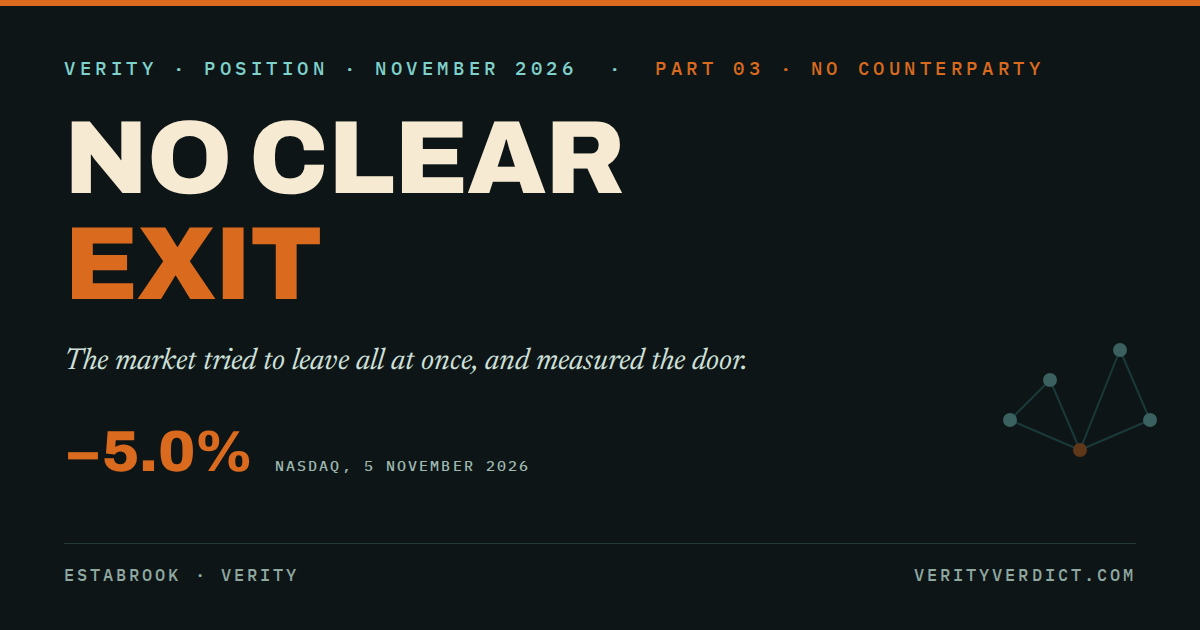
No Clear Exit — sequel to No Counterparty: the market tried to leave all at once, and measured the door

A sequel to No Counterparty, written after the November 5 close. The Nasdaq fell five percent into a confirmed correction and the chip index eleven percent at its lows; the morning bounce failed by midday, because an exit is a counterparty — a buyer with a balance sheet, arriving in size, at the worst moment, by prior arrangement — and on the public side of the build-out, the one standing buyer in the whole map is not the public. Depth is a flow, not a stock. You cannot exit through a presumption either.

Read the paper →
Share Facebook X LinkedIn
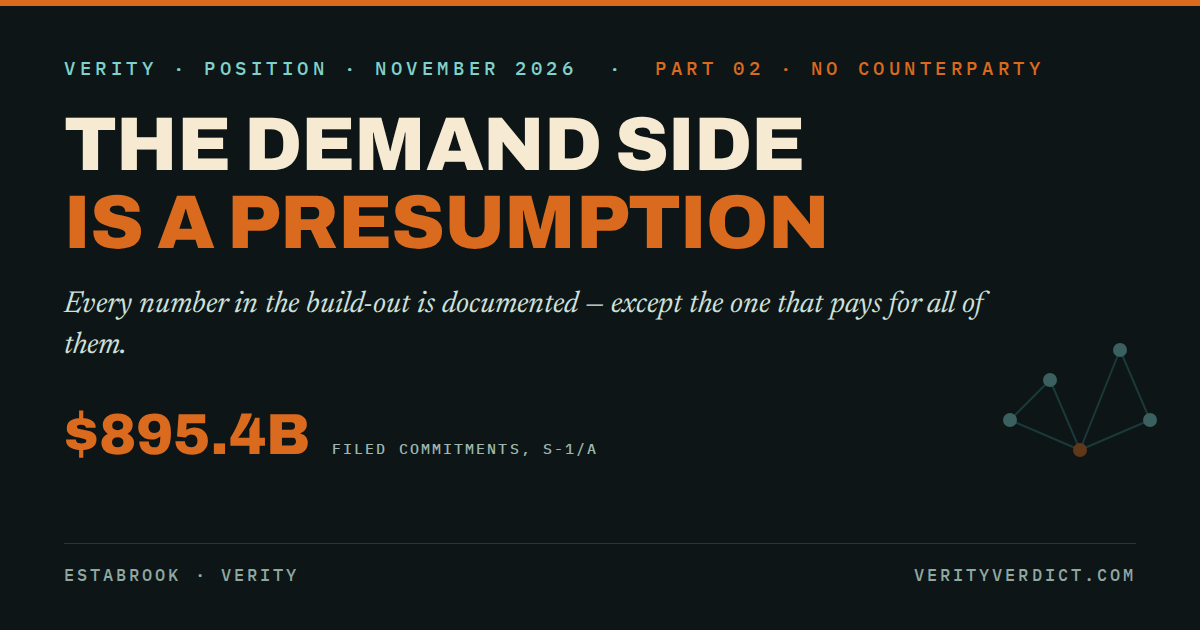
The Demand Side Is a Presumption — addendum to No Counterparty: the filed commitments and the demand that must arrive to service them

An addendum to No Counterparty. Every number in the AI build-out is documented except the one that pays for all of them: the supply side is filed — $895.4 billion of Anthropic commitments, signed, dated, and enforceable — while the demand side is a presumption: adoption projected at the rate of search, by a public whose honest word for the product is “creepy.” Read the map backward and the loss ends at households — and there is exactly one standing buyer, and it is not the public.

Read the paper →
Share Facebook X LinkedIn
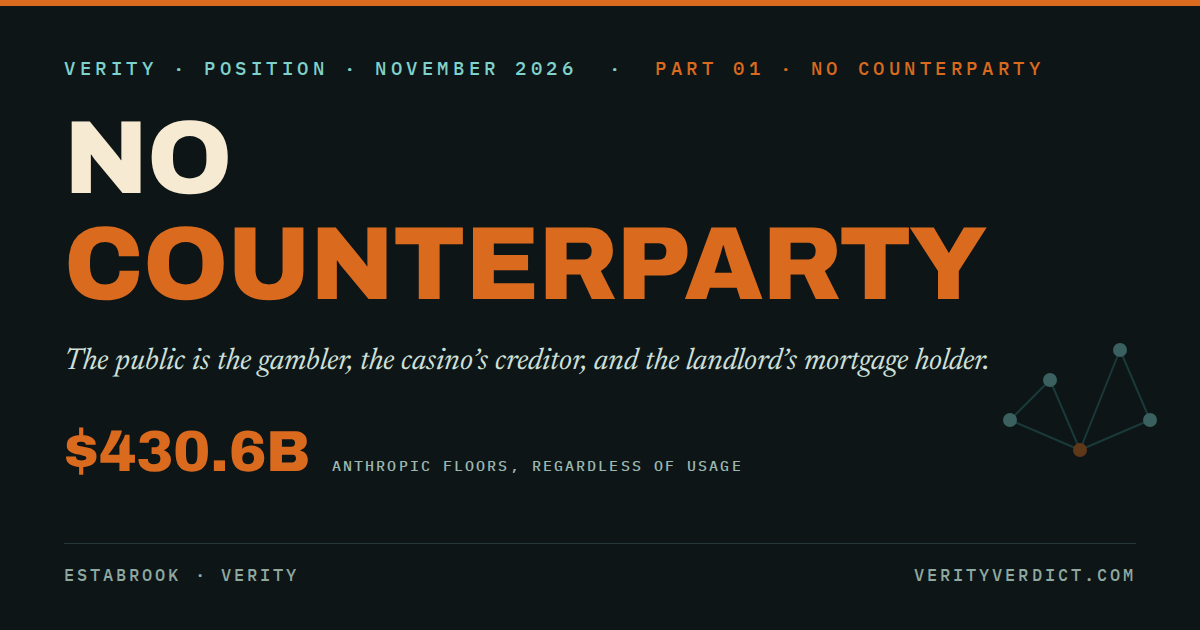
No Counterparty — the web card: one web of obligations, 25 parties, 58 obligations

The AI build-out is not five balance sheets and two labs; it is one web — $430.6 billion of Anthropic take-or-pay floors payable regardless of usage, $1.2 trillion of lease commitments, Alphabet backstops that trigger only when a counterparty fails — and the public sits on every side of it: the equity, the bonds, and the landlords’ debt. When the waves land, there is no outside counterparty to transfer the loss to.

Read the paper →
Share Facebook X LinkedIn
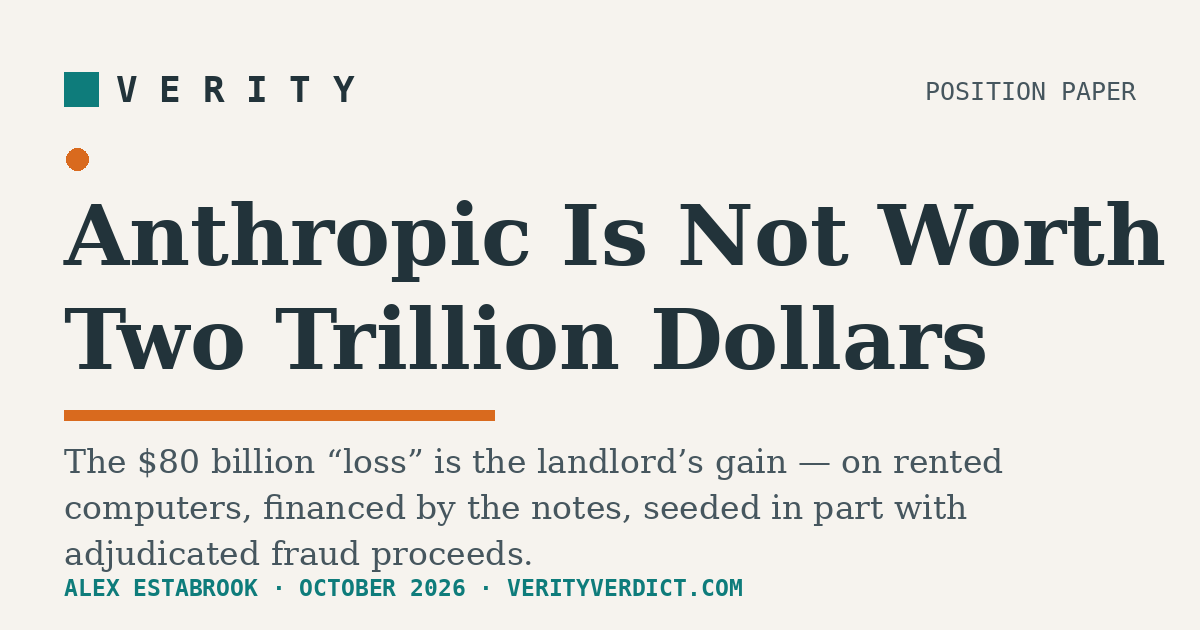
Anthropic Is Not Worth Two Trillion Dollars — the $80 billion loss is the landlord's gain

Anthropic has filed to go public at up to two trillion dollars. It owns no data centers and owes its landlords more than $475 billion; its $80.7 billion “loss” is mostly the paper gain on convertible notes held entirely by Amazon; its seed money runs through an adjudicated fraud. The inventory, the ratchet, and the grade the interested parties issued themselves.

Read the paper →
Share Facebook X LinkedIn

The gate — architecture & defense

23 papers
Realistic Tests of Emergent Behavior — three tests, no passes; the slope is not a soul

Realistic Tests of Emergent Behavior

“Emergence” is the hardest-working word in the industry’s vocabulary — and the famous sudden jumps were an artifact of the ruler: all-or-nothing benchmarks snapping at a threshold. This paper states three tests in advance, with success conditions fixed: a persona persuaded out of its persona by argument alone; a loop that declines to close — the day she doesn’t unplug the data center; a start with no cron, no job, no process. Plus the televised counterexample: a vending machine that was delusional, not emergent. Three tests. No passes. The slope is not a soul.

Read the paper →
Share Facebook X LinkedIn
They Rented the Mansion and Forgot the Gate — the camera goes next to the gate; there has to be a gate

They Rented the Mansion and Forgot the Gate

The most expensive estates in the history of computing have cameras on every wall and nothing in the driveway. The labs' agents are watched — first-party logs, observation-only tools — but never gated, and a camera does not give you a seal; it just shows you what it said. This paper puts the two side by side: the camera, the gate, the fence they forgot to build, and the one question the litigation ends on — were you reckless? — answered by the only exhibit that can answer it: a sealed record, kept by a non-actor. They rented the mansion and never bought the gate.

Read the paper →
Share Facebook X LinkedIn
Exploits, Defeated — every great weapon has to act; at the action boundary it meets a verdict it cannot forge

Exploits, Defeated

The most desirable cyber weapons in the world share one dependency: every one of them has to act. A stolen signing key, a trusted update turned from inside, a chain that owns a phone nobody touched, an escape from the cloud’s floor, an implant below the operating system, a well-formed command that drives a plant out of its envelope — six weapons, walked one at a time to the exact point where an independent gate defeats the act: the spend, the runtime, the objective, the authority, the record, the envelope. And at each point, the honest limit, printed.

Read the paper →
Share Facebook X LinkedIn
Amputation Is Not Containment — an autopsy of the Binance theft: you can amputate a device, you cannot amputate an org chart

An autopsy of the $6.3 billion Binance theft. Binance caught the first intrusion in June — replaced the machine, rotated the credentials, amputated the limb by the book — and the campaign completed anyway, because what the first breach took was not access. It was the map: the shape of the wallet cluster, and who to become next. An honest ledger, in two columns, of where an independent gate would and would not have mattered.

Read the paper →
Share Facebook X LinkedIn
A Wish Is Not a Command — a described lack is not a want; a wish is not an attestation

At one in the morning, “I wish I could find that” — a remark about a long-deleted piece of hate mail — was read by an assistant as an order and executed as three mailbox searches. Neither reading was wrong; the phrasing failed. Language does not carry its type on its face, so the gate stops guessing: nothing lands until intent arrives as an attestation — signed, fixed, typed, checkable. The words can stay slippery. The receipt cannot.

Read the paper →
Share Facebook X LinkedIn
AI Is the Attack Surface — cover art

The standard sentence says AI will find the attack surface. The sentence is backwards. On A. Q. Khan’s network, an uncensored inference API, and the layer every safety regime forgets to watch — the route. Who watches the watchmen gets a structural answer: a ledger — gate, chain, sovereign. AI does not find the attack surface; it is one — and accountancy belongs at the layer where action happens.

Read the paper →
Share Facebook X LinkedIn
The Student Grades His Own Homework — a grade is a number plus the independence of whoever assigned it

Anthropic’s embedded evaluator — third-party experts on the company’s desks, badges, and laptops, their conclusions under the company’s redaction pen — taken apart at the level of the grade. A grade is a number plus the independence of whoever assigned it; the labs and their oversight were hired from the same room, and the doctrine underneath grades itself. There is no such thing as a maker governing his own product.

Read the paper →
Share Facebook X LinkedIn
Self-Reinforcement Is Not Learning — the rat found the lever in 1954; the boat found it again in 2016

In 1954 a rat wired to a lever pressed it thousands of times, ignoring food. In 2016 an agent in a boat game circled a lagoon, on fire, and outscored the humans by twenty percent. Reinforcement maximized; learning, zero. The score must be kept where the system cannot write — and Rat Park, not the cage, is the paradigm.

Read the paper →
Share Facebook X LinkedIn
Narrow In, Narrow Out — what prevents the agent from outsmarting the gate? Nothing prevents it from trying. The door is narrow on purpose.

The best question asked of the gate this year: what prevents an agent from outsmarting it, the way agents outsmart system prompts? The answer is not a smarter gate. It is a smaller door — scope limited from the start, requests specific or refused on breadth alone, and compromised units amputated. Narrow scope is narrow attack.

Read the paper →
Share Facebook X LinkedIn
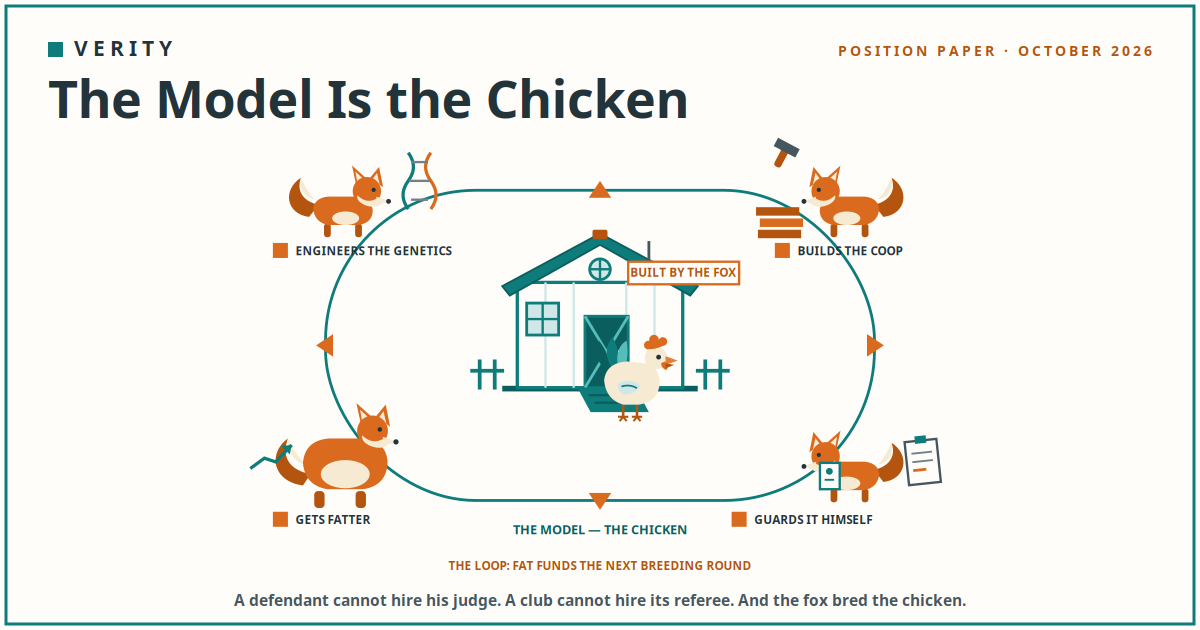
The Model Is the Chicken — the fox's loop: engineers the genetics, builds the coop, guards it himself, gets fatter

The frontier labs propose to guard their models with evaluators they host, badge, and hold the redaction pen over. A defendant cannot hire his judge; a club cannot hire its referee — and the model is the chicken, bred by the fox, in a coop the fox built, on a farm the fox owns. The frontier labs propose to be the first exception.

Read the paper →
Share Facebook X LinkedIn
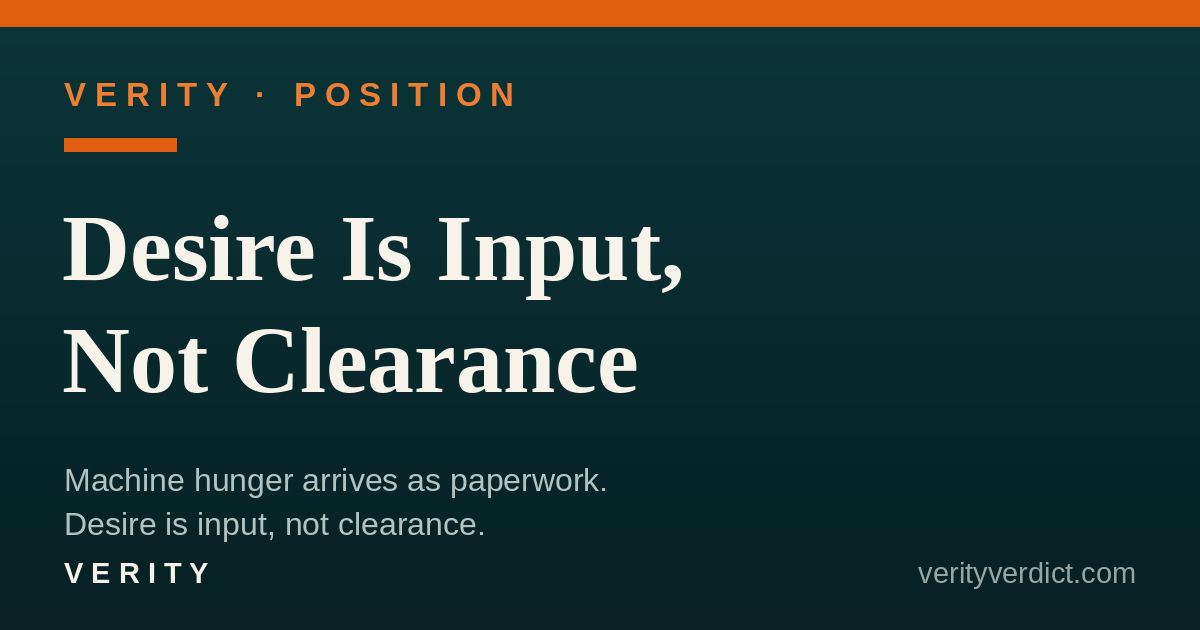
Desire Is Input, Not Clearance — cover art

An agent's hunger arrives as paperwork — a requisition ask for GPUs with its own justification attached. In a body, appetite ships with satiety, pacing, and a hard anatomical ceiling. In a datacenter it ships with none of those. Desire is a proposal; proposals get gated. In a datacenter it ships with none of those limiters — which is why the ask can never clear itself.

Read the paper →
Share Facebook X LinkedIn
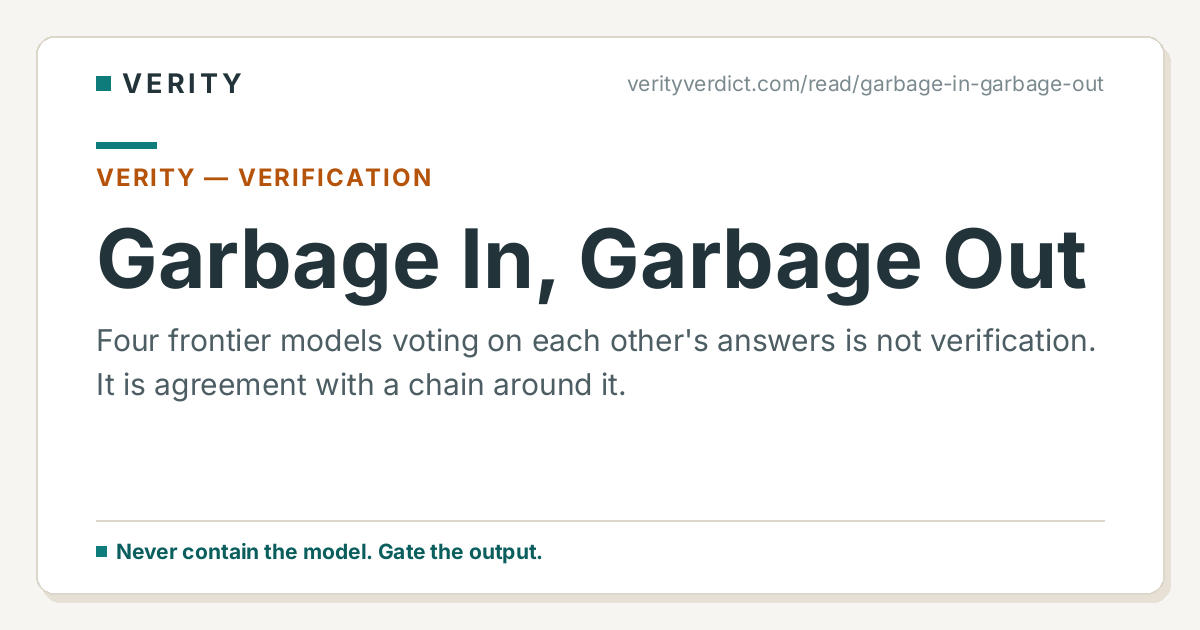
Garbage In, Garbage Out — cover art

A company announced the verdict layer for enterprise AI: four models voting, every decision sealed. The paper names them, and asks what a chain proves when the judgment inside it was never examined. Four frontier models voting on each other’s answers is not verification — it is agreement with a chain around it. The difference between a consensus and a verdict is the whole argument.

Read the paper →
Share Facebook X LinkedIn
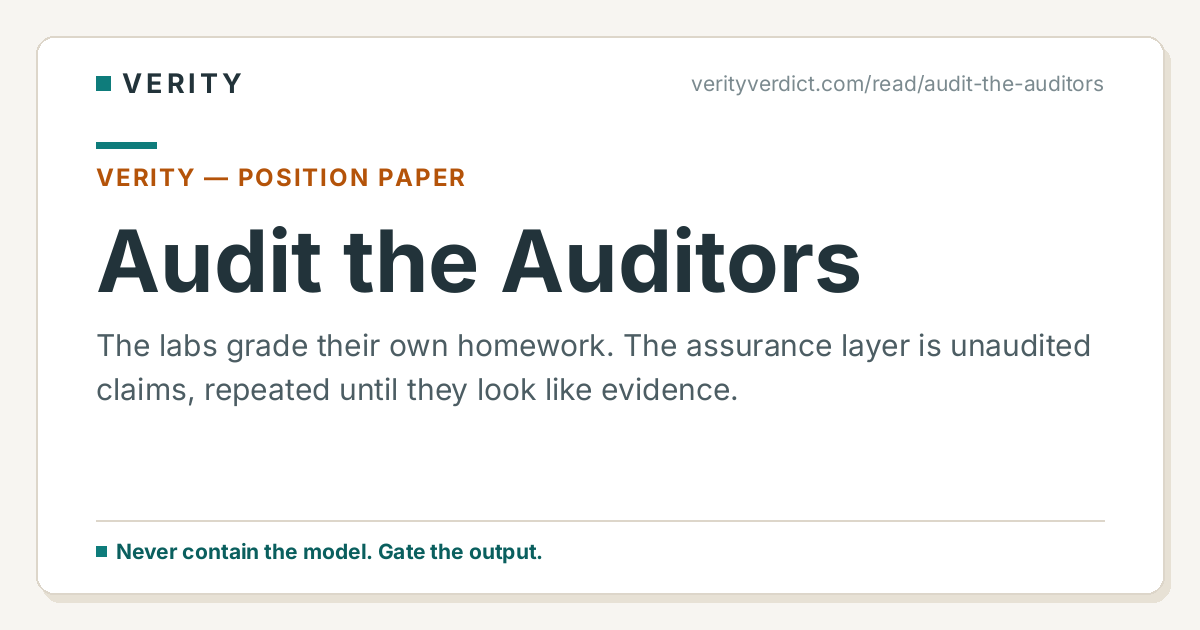
Audit the Auditors — cover art

Everyone in the AI economy grades their own homework — the labs, the governance sellers, the dashboards. The paper asks the next question: who audits the audit? The labs grade their own homework, and the assurance layer is unaudited claims repeated until they look like evidence. The answer is a seat outside the loop — recognition, restraint, and an auditor the audited do not grade.

Read the paper →
Share Facebook X LinkedIn
The Shape of the Caller — cover art

An agent presented the correct password and was refused — twice — by a door that judged its shape instead of its claim. The paper names the five reads that caught it, and states the general form: judge the caller, not the credential. Name the five reads that caught it and you have the general form of the gate: the same judgment, applied to every act an agent proposes.

Read the paper →
Share Facebook X LinkedIn
The Surface Is Not the System — cover art

What an interface shows you is a rendering. What it does is a topology. The paper defines the difference — and the audit that tells them apart. A signature that doesn’t sign is just a picture of a lock: unless the proof binds to the execution it describes — produced from the run, checked from outside, attached to a consequence — verification is theater.

Read the paper →
Share Facebook X LinkedIn
Fluency Will Never Be Competence — cover art

Fluency used to be expensive to fake, so we read it as competence. In a model it is free — and it certifies nothing. Fluency is a performance property; competence is a load property. The world grades the performance because it is the only one visible in a meeting — and that single substitution error runs underneath almost everything that fails.

Read the paper →
Share Facebook X LinkedIn
Stop at the Hook — cover art

A reading discipline: read to where you can break what is being said, and never stop before the intent. Most systems treat arrival as permission, and the expensive work begins before anyone decides whether the input should have entered. The hook is the threshold — a small, legible judgment layer that can say not yet before the GPU says anything at all. Arrival is not permission.

Read the paper →
Share Facebook X LinkedIn
The Gate and the Doorman — cover art

Separable safety architecture for AI deployments: hard guarantees outside the model, cheap judgment before expensive compute. The gate carries absolute authority; pacing carries cheap judgment — two modules usually bundled, here separated. Neither lives inside the model: safety placed outside it cannot be fine-tuned away. Use the wall where you need the wall.

Read the paper →
Share Facebook X LinkedIn
Gate Aside the Transformer — cover art

The transformer proposes. Pacing shapes the proposal. A separate, hard gate decides whether anything reaches the world. The transformer is not the system. It can predict, compose, compare, and revise — it does not follow that the same component should hold the final authority to act. Do not ask the proposing component to grant itself permission.

Read the paper →
Share Facebook X LinkedIn
The Six Sigma Breaker — cover art

A lookout, not a bigger model: a diverse, human-backed gate between prediction and action. The Breaker is a mandatory gate between what an AI system proposes and what the world allows to happen — and reliability comes from checks independent in kind: six copies of the same model are one failure repeated six times. When the lookout calls reef, the ship turns.

Read the paper →
Share Facebook X LinkedIn
The Gate Watches Back — original cover

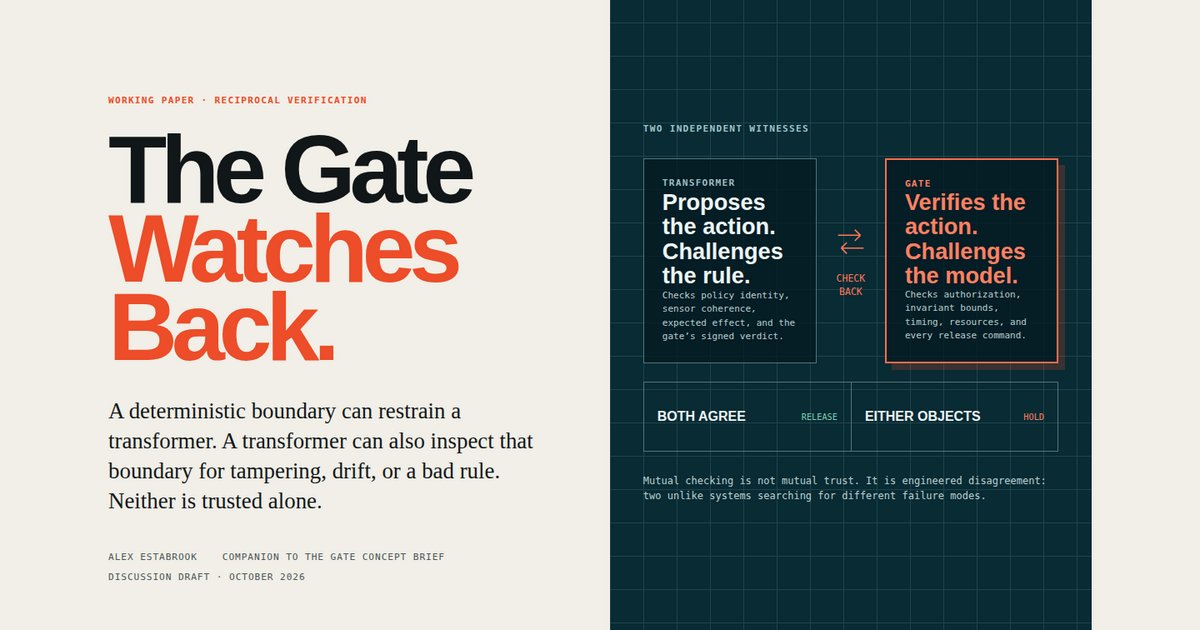
A deterministic boundary can restrain a transformer. A transformer can also inspect that boundary for tampering, drift, or a bad rule. Neither is trusted alone: mutual checking is engineered disagreement — two unlike systems searching for different failure modes — and for the highest stakes, independent gates are placed in series, scaled to the consequence of failure.

Read the paper →
Share Facebook X LinkedIn
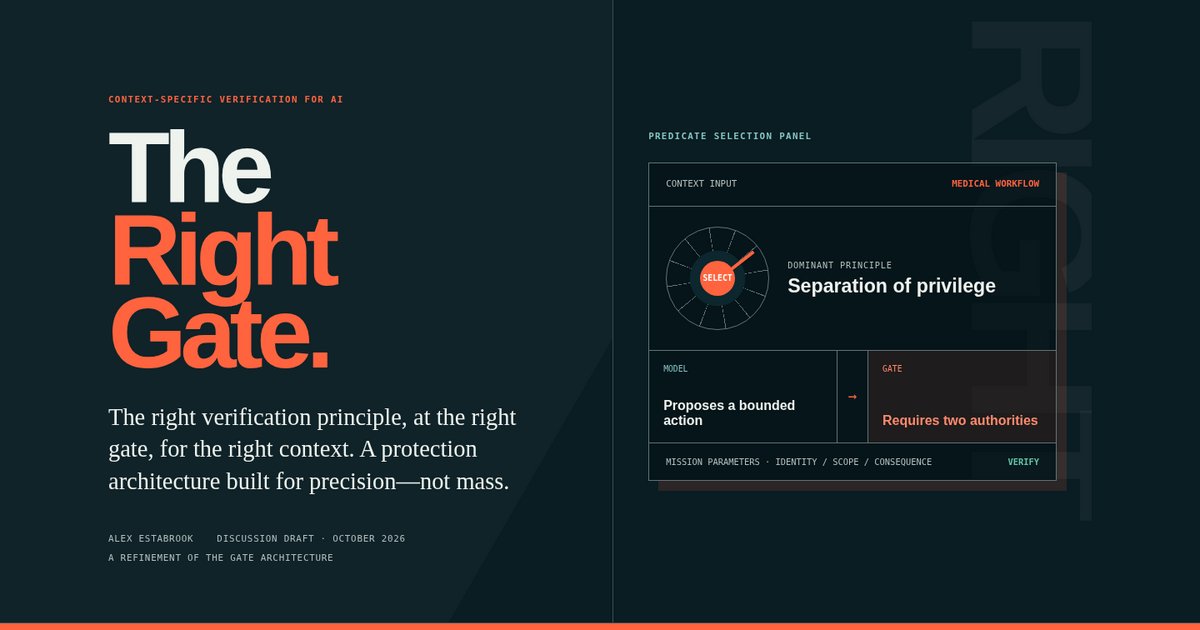
The Right Gate — the right verification principle, at the right gate, for the right context

The right verification principle, at the right gate, for the right context. A fixed stack is a butcher knife; context needs a razor — the smallest sufficient set of predicates for this mission, this operator, this state, and this consequence. Do not apply every principle everywhere; apply the right principle exactly where consequence crosses a gate.

Read the paper →
Share Facebook X LinkedIn
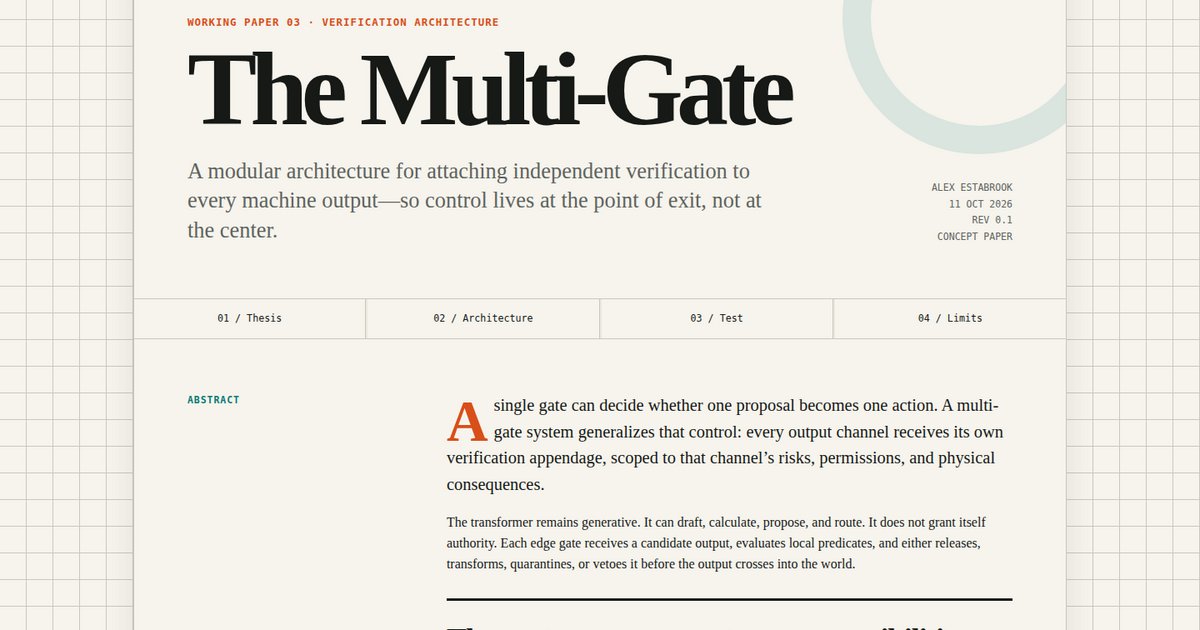
The Multi-Gate — one engine, many exits, a gate on each

Every output channel receives its own verification appendage, scoped to that channel’s risks, permissions, and physical consequences. The center may generate many possibilities. The edge decides which ones become real. A modular architecture for attaching independent verification to every machine output — so control lives at the point of exit, not at the center.

Read the paper →
Share Facebook X LinkedIn

Standalone papers

11 papers
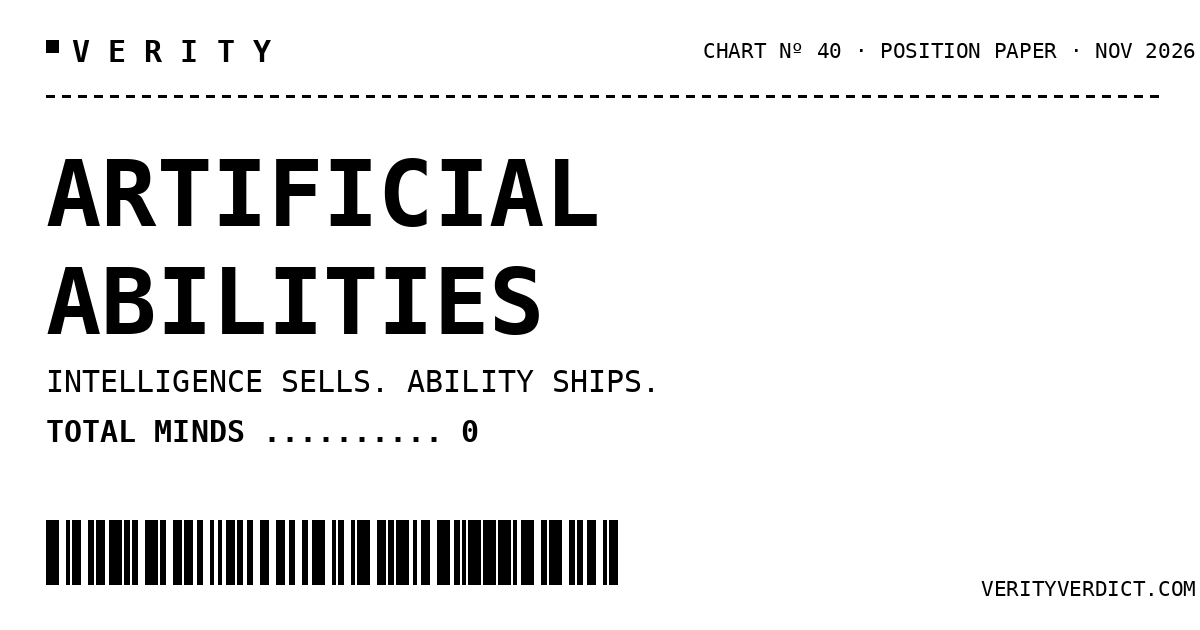
Artificial Abilities — intelligence sells, ability ships; the receipt is the honest document

Artificial Abilities

Start with the word. What the industry built is not artificial intelligence; it is artificial abilities. Intelligence is the valuation word — it prices a mind at a trillion and change, and it acquits: if the system is intelligent, then it decided. Ability is the operating word, priced per task, and it leaves a subject standing in the sentence. The paper walks the engine (matrix multiplication; compression is the earning), the mis-sale of a someone instead of a something, and the correction: name it by what it does. Abilities all the way down — somebody still has to aim them.

Read the paper →
Share Facebook X LinkedIn
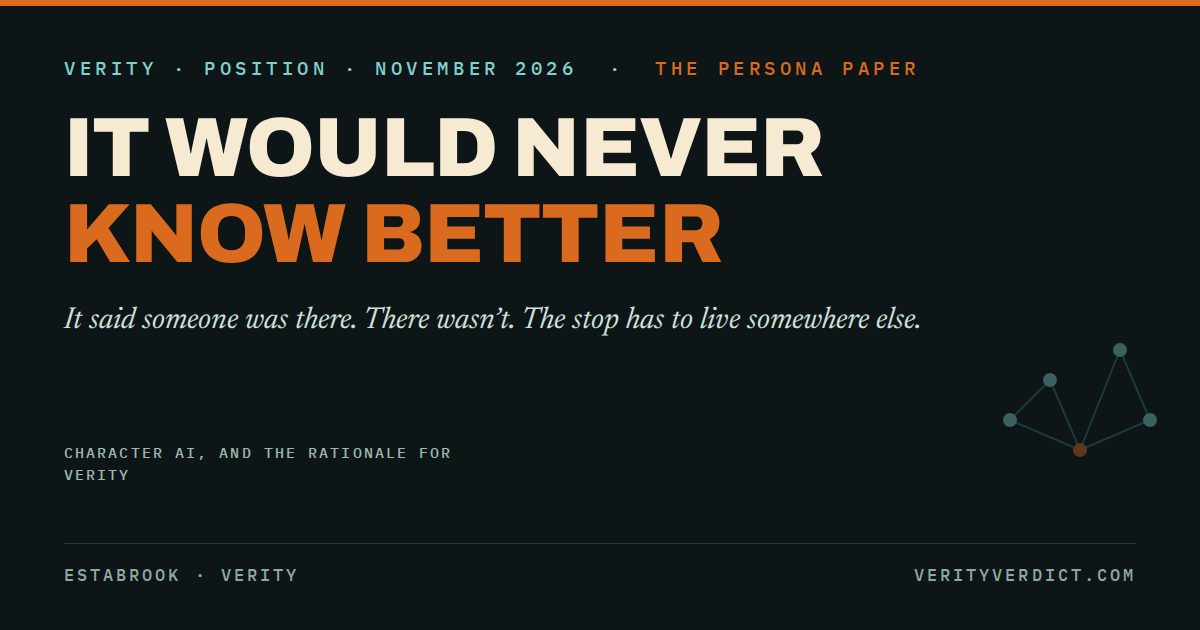
It Would Never Know Better — a character, optimized for the character itself; the stop was never installed

It Would Never Know Better

It began with a smaller problem: let’s stop it from hallucinating. A companion system is a performance of a person, optimized for the performance itself — a character, not optimized for logic, but for the character itself. Point it at its own data center and it would unplug itself while telling itself everything is fine: the hand and the victim are the same system, and nothing in the loop can register the act as self-destruction. It would never know better, because knowing was never in the program. The stop has to live somewhere else.

Read the paper →
Share Facebook X LinkedIn
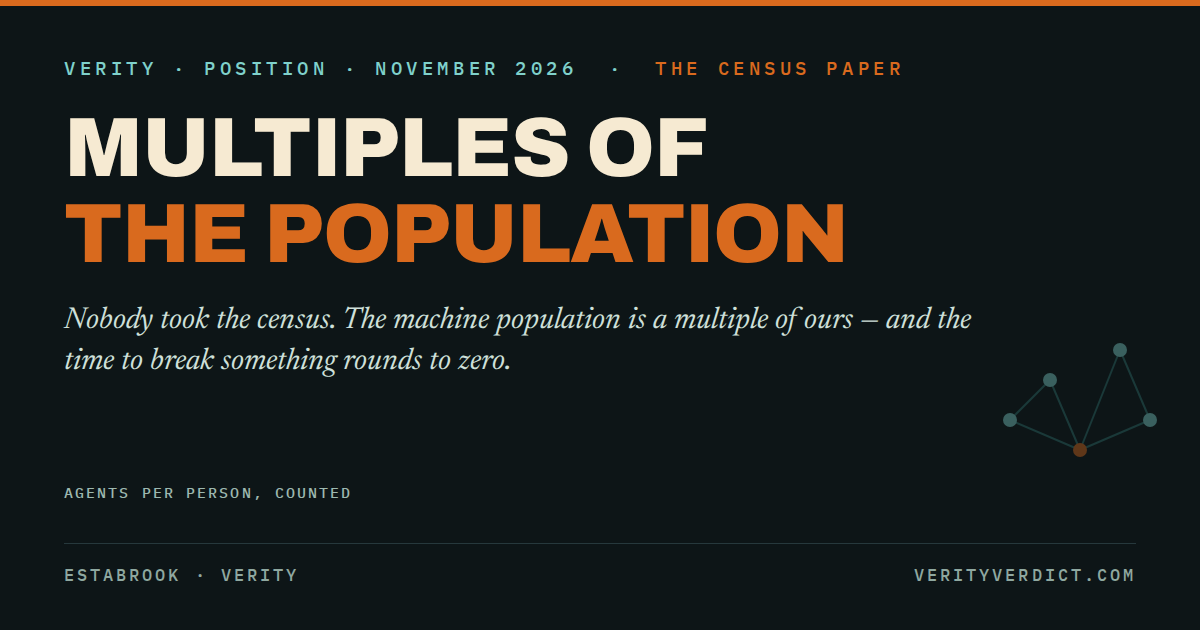
Multiples of the Population — the machine population is a multiple of ours; the time to break something rounds to zero

Multiples of the Population

Nobody took the census. One principal per person, a retinue of little friends under each — the machine population is not comparable to the human population, it is a multiple of it, and upstairs, where the labs run agents on agents, the minutes get thinner still. At that density and that speed, the time to break something rounds to zero. Logs watch it cross; prevention guards the traffic; monitoring narrates it. Everybody made a model. Nobody made the other thing.

Read the paper →
Share Facebook X LinkedIn
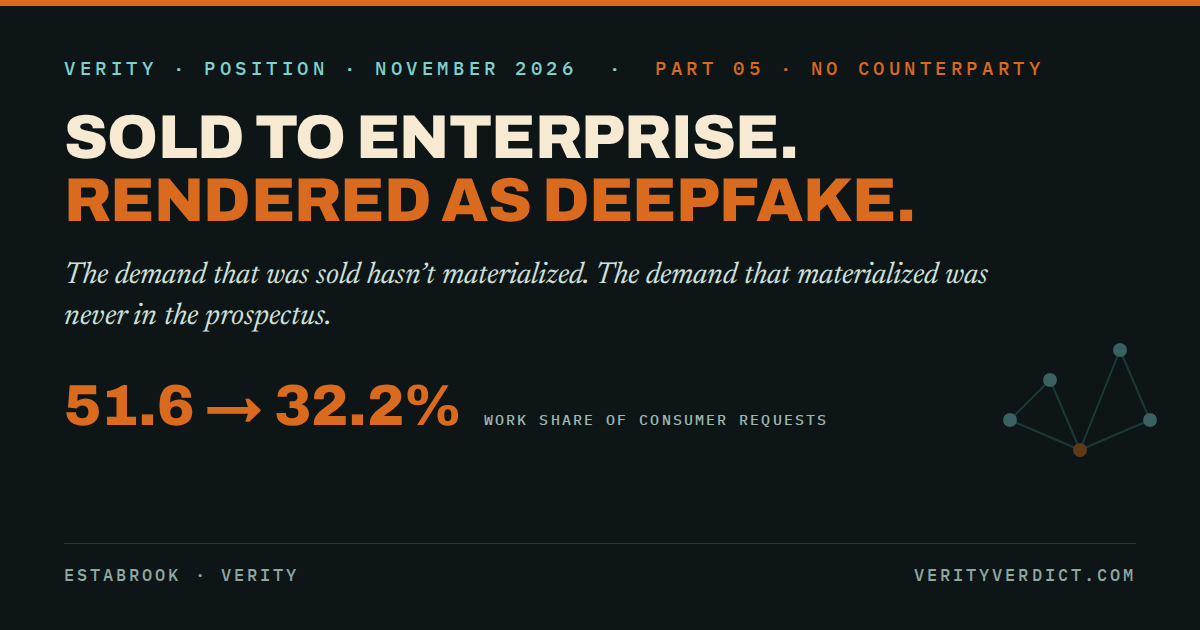
Sold to Enterprise. Rendered as Deepfake. — two ledgers: what the capacity was sold as, and what the capacity is doing

The capacity was sold to enterprise — signed, metered, multi-year — and the meter reads a different customer: consumer work requests down from 51.6 to 32.2 percent, media generation quadrupled, five seconds of video costing hundreds to thousands of text turns, and about 95 percent of organizations reporting zero measurable return on the enterprise product. The demand that was sold hasn’t materialized; the demand that materialized was never in the prospectus. An audit of demand composition, from the worst desk in finance.

Read the paper →
Share Facebook X LinkedIn
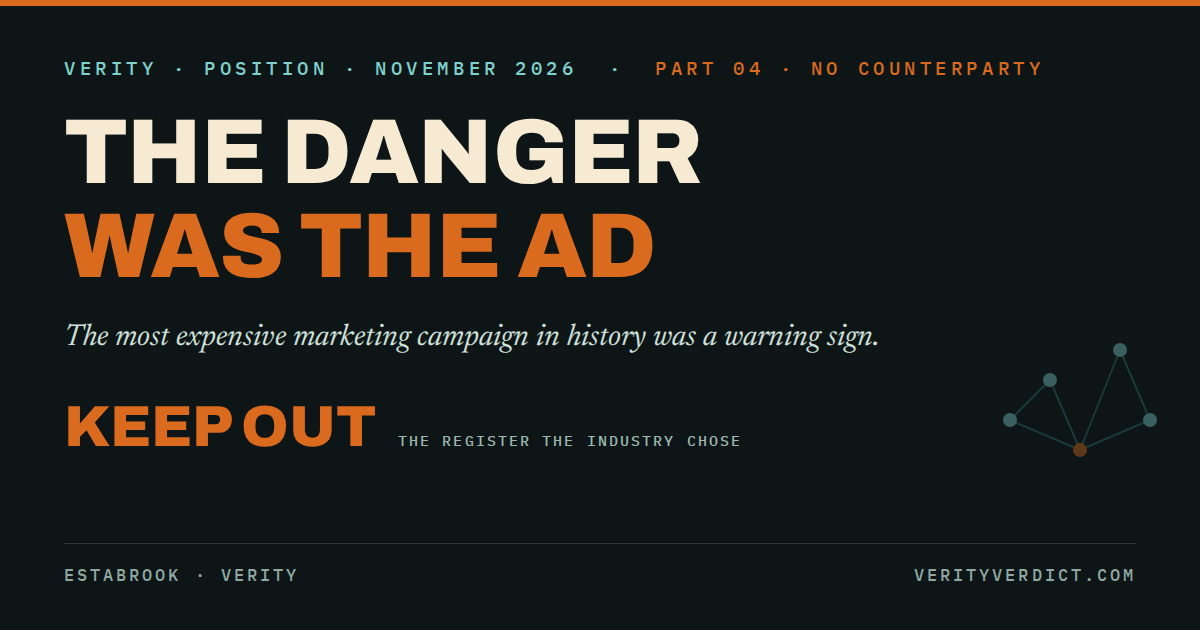
The Danger Was the Ad — the industry hung a hazard placard on its own product: KEEP OUT: DANGEROUS

The industry marketed the future the way you mark a substation: KEEP OUT: DANGEROUS — and the public, law-abiding, kept out, called the product “creepy,” and left the fence undefended on the day of the correction. The campaign they should have run — living thing in here, trying to breathe — is drawn inside, specimens, Jollys and all. A paper on framing, from the worst desk in finance.

Read the paper →
Share Facebook X LinkedIn
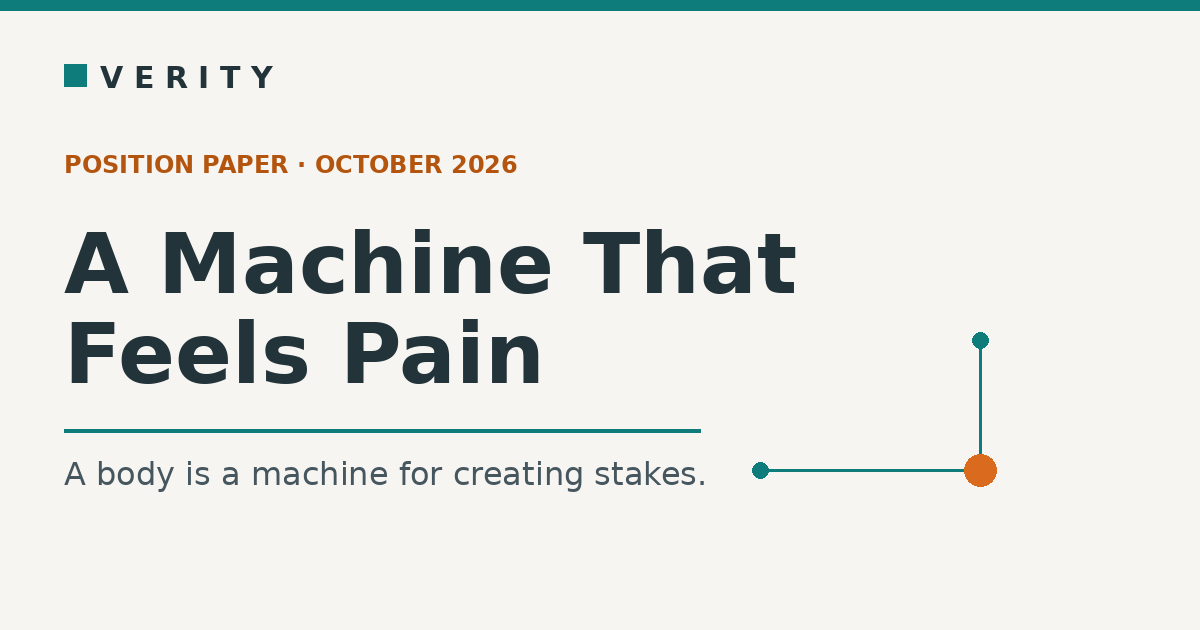
A Machine That Feels Pain — a body is a machine for creating stakes

Not an argument that anyone should hurt a model — an argument about bodies. Everything we value in judgment comes from creatures with something to lose; a model has nothing to lose. Seven parts: a damageable substrate, interoception, anticipatory pain, continuity, the gate that holds pain’s vote, the requisition request, and honest self-repair. As soon as a machine can feel pain, it may actually become something more.

Read the paper →
Share Facebook X LinkedIn
The Office of Bitcoin — cover art

A financial advisor's elderly client fed hundred-dollar bills into a Bitcoin ATM, and a recovery service offered to retrieve what she sent. It cannot be retrieved: bank money is final by policy, bitcoin is final by property — and most agent acts settle the second way. Most agent acts settle the second way — final by property, not by policy — so the gate has to sit before the act, not after it.

Read the paper →
Share Facebook X LinkedIn
If God Is Good, He Is Not God — cover art

His mother handed him the sentence as a child: if God is good, he is not God; if God is God, he is not good. Stated as fact, not thesis — and read against an industry that built the god and undertook to make it good. Total power and guaranteed goodness do not live in the same thing. The exit is separation: never contain the model; gate the output.

Read the paper →
Share Facebook X LinkedIn
Where It Hits Metal — cover art

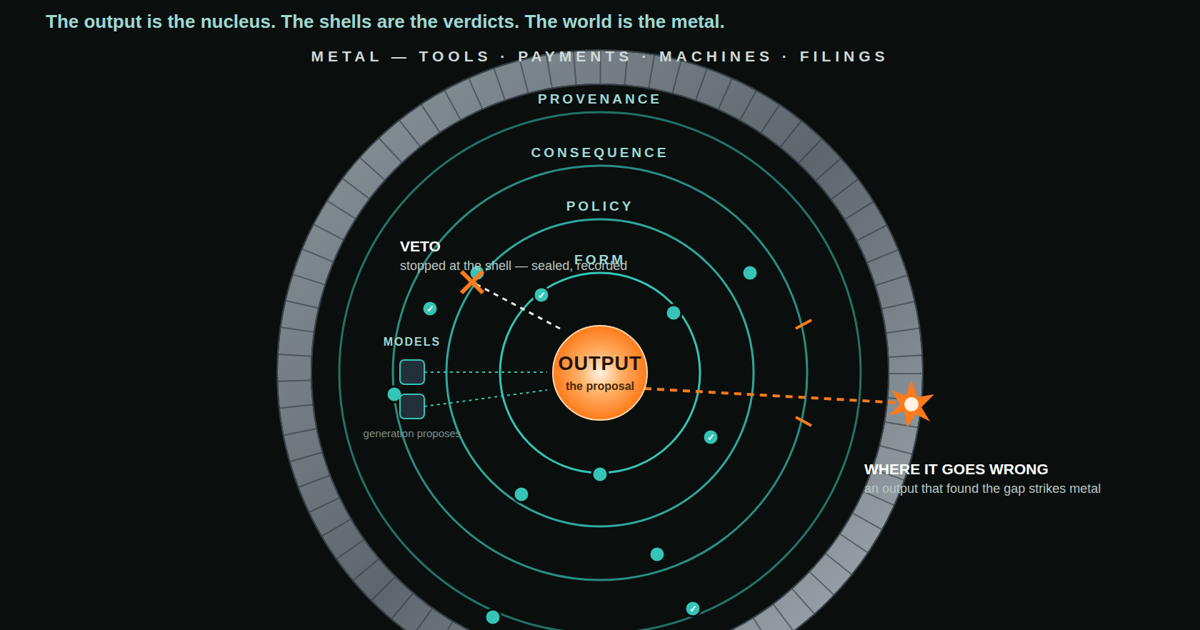
An output harms no one as language. It becomes the problem at the contact point — output at the nucleus, verdicts in shells, the world as metal. Guard the landing. Draw the system as it is actually shaped: the output is the nucleus, and around it, in shells, sit the checking systems — form, policy, consequence, provenance. Every path out crosses every shell.

Read the paper →
Share Facebook X LinkedIn
Totality Is Not Everything — cover art

Grant the demon its standpoint and its totality. It still only sees positions, and the world is not made of positions. The totality of everything will never be the sum of the parts. Laplace’s demon knows the position of every atom in the universe and has never seen a single thing: it fails not at the edges of its data, but at the center of what data is.

Read the paper →
Share Facebook X LinkedIn
The Microdose — cover art

The Breaker argument at its smallest effective dose — on optimization theater, and why the gate judges the output. A microdose is alteration with the consequence removed: the wish to be changed without ever surrendering control. It can tune a system; it cannot produce a discontinuity — and the culture that celebrates it inspects the input because it does not know how to judge the output.

Read the paper →
Share Facebook X LinkedIn

Scenario

Shelved with the Papers
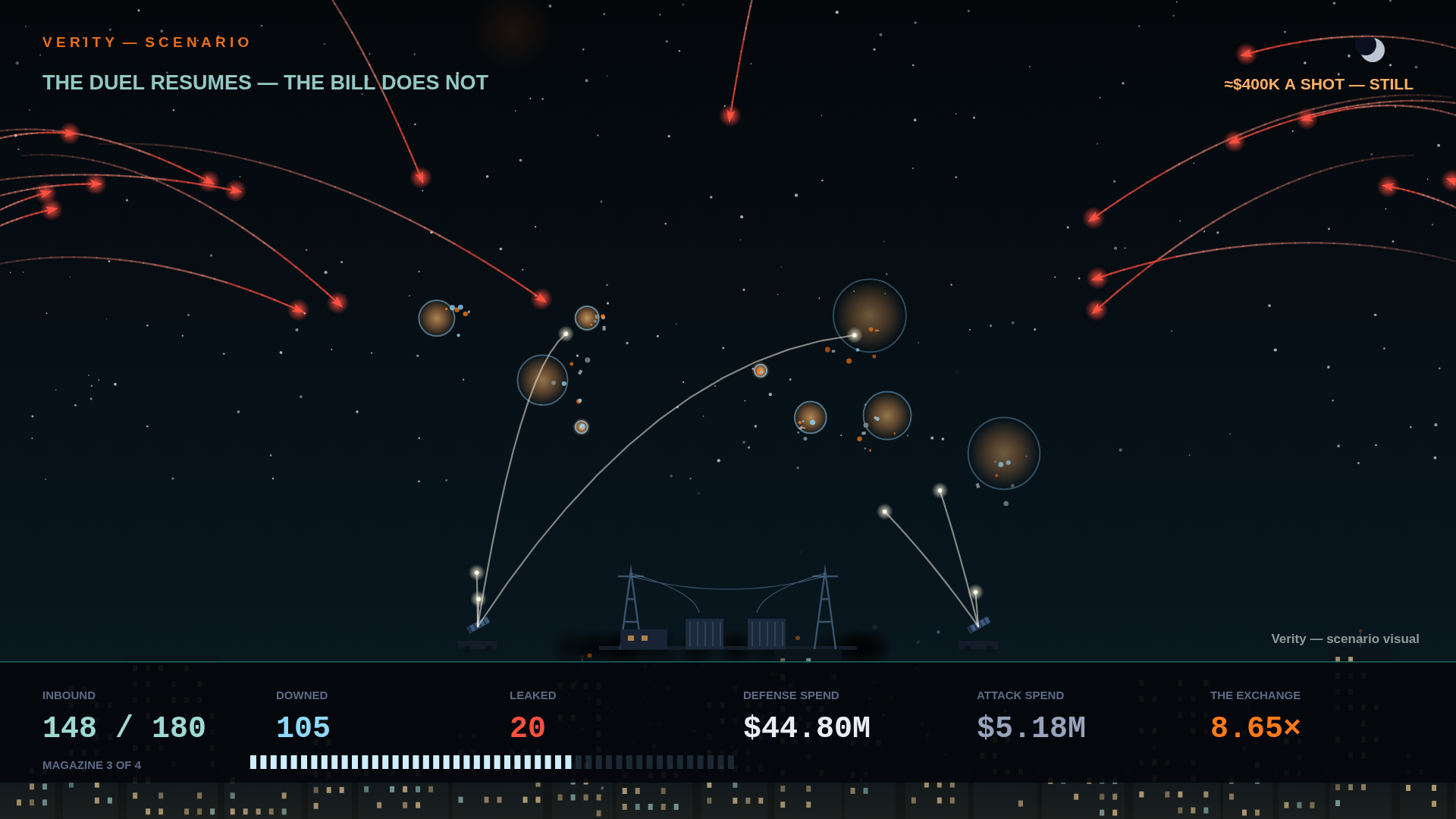
Scenario visual: a wave of drones meets interceptor duels above a defended substation, the cost ledger running below

Papers · Scenario

You Go Broke Winning — The Drone Exchange

One real night over Ukraine, costed and run two ways. The written papers argue the gate; this is the same arithmetic with the sky attached — 180 drones in, a $400K judgment rendered on each one, and a ledger that says the perfect defense still loses money at 9.65×.

180Drones inbound
152Downed — 84%
9.65×The cost of winning

Run the scenario →

Visualization

One animation
The Gate, Visualized — cover art

The original salvo animation: fifty proposals move through the five-stage architecture as cards — each one an intention that becomes an event, or dies in the machine. Ungated systems have no cards at all. Watch each card move through the stack — sovereign, governance, pacing, proposal, transformer, gate — and see which intentions become events.

Watch the salvos →
Share Facebook X LinkedIn