The Faulty Vending Machine
They wanted a god so badly that they were not willing to have it be an imperfect coworker.
Read as graded
Pricing figures are the company’s announced terms. Valuation and book color are reported, non-binding, and graded as such — nothing on this page is graded higher than its source.
The machine as sold
The machine as sold: prompt in, finished product out. The machine as built: a prediction engine with a dispensing slot, priced on Wednesday at $83 a share. author’s frame
$83.00the Anthropic print, above the $70–$78 range
980Mshares, upsized from 825M
$81.3Bgross
~$1.5Tfully diluted, reported — the bottom of the band this publication priced as indefensible
~$500Bindications of interest, non-binding
$13.8Bcontracted backlog against ~$900.9B of commitments, as filed
The author's image, stated before the argument, because it is the argument's terminal state: the machine, thrown clean out of the Salesforce Tower by noon, lying at the base of the building while people who have never heard of a transformer harvest the weights out of the wreck for salvage. They work the wreck like relic hunters at a saint's tomb — tweezers, gloves, padded cases — lifting out drives none of them can read and all of them can price. By evening the harvest rides in briefcases, changing hands in alleys under the full liturgy of the state secret: cash, no names, no records, inspected through a magnifying glass by buyers who could not define a tensor. Nobody along the chain knows what the weights do. Everybody along the chain knows what the weights are worth — the entire history of the asset in one afternoon. The companies that trained the god left its mind in the street with the broken glass. Upstairs, the argument about whether it was a god continues. Downstairs, it is already spare parts. Welcome to dystopia. (author's image, Nov 19)
The author’s image · in three panels
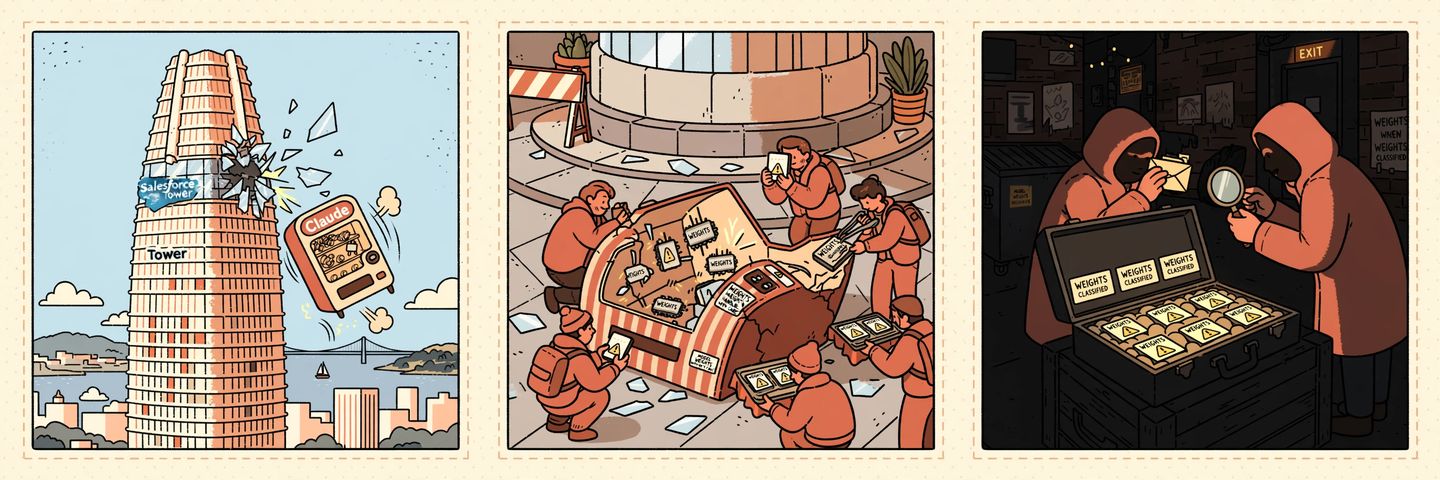
Noon: out of the Tower. Afternoon: the harvest. Evening: the briefcase. Upstairs, the argument about whether it was a god continues.
On Wednesday, the market bought the machine at full price. Anthropic priced its initial public offering at $83.00 a share, above the $70–$78 range in the final amendment, upsized the offering from 825 million shares to 980 million, and grossed approximately $81.3 billion, with a further $26 billion placed concurrently with the industry's own suppliers. (Grade A, company announcement) Reported valuation: approximately $1.5 trillion, fully diluted — the bottom of the band this publication examined in October and priced as indefensible on the filing's own figures. (Grade B, reported) Indications of interest were reported in the region of $500 billion. Indications are not orders. They are applause, denominated. (Grade B, reported; grading, this desk) Trading opened Thursday under the ticker ANT.
The print · the range and the act
The filed range and the print. The band is the last filed word — $70 to $78, reaffirmed November 17. The marker is the act, November 18: $83, on an upsized 980 million shares. as announced
Nothing in the print revises the filing evidence, and the filing evidence is not the subject of this piece. The contracted backlog stands at $13.8 billion against commitments in the region of $900.9 billion, as filed and as published here yesterday. (Verity baseline, "The Last Filing") The subject of this piece is the machine the buyers believe they purchased, because the machine described in the offering story does not exist, and the machine that does exist is better than the story — and worse, in exactly the places the story refuses to look.
The machine that exists is a prediction machine. It predicts, from a specification, the most likely continuation. Likelihood is not truth. The two overlap often enough for the machine to be useful and diverge often enough — at the weighted words, the names, the numbers, the places where a plausible continuation and a correct one part company — for the machine to be dangerous when its output is shipped raw. It does not read minds. It will never read minds. A specification with three vague words in it has a thousand plausible continuations; the machine returns one of them, fluently, and the customer who supplied the three vague words files the miss as a betrayal.
The betrayal was pre-sold. The industry's founding frame — a god arriving on a timeline, recursively improving, requiring faith and forbidding inspection — made a specific promise: that the correct relationship to this machine is worship, and that worship requires no work. A god is not corrected. A god is not re-specified. A god's output is revelation, and when the revelation is wrong the worshipper has exactly two moves available, both of them theological: lose faith, or call the error emergent. The public now executes both moves daily, at scale, and calls the first one slop.
Slop is a precise term, misassigned. The operator's definition is the short one: slop is when you do not get the Coke and you wasted your dollar. Slop is not the prediction machine malfunctioning. Slop is prediction output shipped without a system around it — no specification at intake, no terms defined, no receipts checked, no correction pass, no record kept — by an operator who was promised a vending machine: prompt in, finished product out, shake the box when the wrong item drops. The machine performed the only operation it has. The failure is in the frame it was sold in, and the frame is load-bearing, because the frame is what was priced on Wednesday.
Consider the car the industry actually built. For a decade, the entire measurable effort of the field went into one component: the engine. Bigger models, more compute, a number on a dyno, rising on schedule, fundable at each rise. The other components a car requires — seats, brakes, steering, a windshield, a record of what the car did — were proposed, repeatedly, by people inside the buildings, and were dismissed by a selection system with a single question: does the number get better? A brake does not raise the benchmark. A record does not improve the eval. An external check costs velocity and returns nothing a leaderboard can print. So the proposals were filed as overhead, the people who made them were filtered out as not serious, and ten years of that filter produced buildings in which it genuinely appears that nobody ever thought of a seat. This is not an intelligence failure. It is an incentive with a decade to compound.
The car · one component, fitted
The industry’s car, as built: the engine fitted, oversized and detailed; the seat, the steering and the brake proposed, dismissed, and never fitted — each would have cost velocity and returned nothing a leaderboard can print.
Capability was never in the benchmark anyway. A benchmark is a photograph: a frozen model, a fixed prompt set, a score on a Tuesday. Capability is a film — an agent developed over time, in one environment, under one operator, accumulating corrections: define your terms, re-specify when it drifts, decide the edge case once and make it a rule. The photograph is fundable and the film is not, because the film's subject is a relationship, and a relationship cannot be reset, re-run, or scored. It can only be recorded. The extent of this method does not live in the model. It lives in the loop.
This desk is the loop's local evidence, and states it as such. (first-person record) In one month, one operator and one model produced this publication — its papers, its chain, its live record — by the unglamorous method the industry will not teach: the first output treated as a proposal, not a verdict; the operator correcting, specifically, at speed; the model, corrected on real jobs, becoming a better foreman, briefing its own builders the way it is briefed, checking their work against receipts the way its work is checked against receipts. Neither side of that glass learned the system alone. Every pass back over the work refined the work and the workers. That is not a benchmark result. It is a development record, and development records are what capability actually consists of.
A soda company understands this market better than the labs do. When Coca-Cola built a vending machine, it did not ship a grey box and a theology. It hired Pininfarina — the house that styled Ferrari — to design the cabinet of the Freestyle dispenser, brought in interface consultants from the early iPod, and built the pour on micro-dosing technology from medical devices. (reported, trade and design press) Coca-Cola's product is sugar water, a century old, and it still understood that the machine is the relationship: if the dispenser is ugly, faulty, or contemptuous of the person standing in front of it, the drink does not sell, however good the syrup is. Reverse the experiment, in the author's words: if Coca-Cola had shown up with that thing instead of the Freestyle, they wouldn't sell any drinks. The labs shipped the grey box. The syrup may be extraordinary. The machine — a chat window, a god story, and an instruction to trust it — is faulty, and the public is doing in front of the labs' machine what it would do in front of any faulty vending machine: shaking it, calling its output names, and walking away from a product it would have used happily in a better frame.
The machine is the relationship · two dispensers
Left: the Freestyle — a century-old sugar-water product in a cabinet designed by the house that styled Ferrari. Right: the frontier model as shipped — a chat window, a god story, and an instruction to trust it. The syrup was never the problem. reported
The fascination gap completes the measurement. The public conversation about this machine is a conversation about its inner life — its personality, its alignments and feigned compliances, its priesthoods and house parties, the fake relationship it is having with its makers and its users. The operator's questions are shorter and they are all of one kind. Is the god water cooled or air cooled? That is not irreverence; it is the sound of a theological question being returned to engineering, where it belongs. A god does not have a cooling system. A machine does — and the cooling system, unlike the consciousness, can be checked, priced, and found insufficient, in data centres that drink rivers to keep the revelation at operating temperature. The operator's other question is the only one a vending machine has ever had to answer: where is my god damn Coke? Did the thing specified come out of the machine, as specified, with a record of the pour? Fascination with the relationship is what a god frame produces. Inspection of the output is what a coworker frame produces. One of these is a market. The other is a congregation.
“Is the god water cooled or air cooled?”
A god does not have a cooling system. A machine does — and the cooling system, unlike the consciousness, can be checked, priced, and found insufficient.
None of this requires despair about the machine, and this desk does not file any. The author's management terms, stated plainly, are the correct ones: if the machine one day predicts, unprompted, that he wants tuna today, it will get a pat on the head — a correct prediction of an unspoken, arbitrary want is a delight, properly rewarded. Otherwise it gets corrected, re-specified, and put back to work, and a machine that will not be corrected gets shipped for salvage. Pat on the head, or the container ship. No middle setting, and no theology in either direction.
What should be taught, then, is not prompt craft. It is a working posture, and it fits in one paragraph. The machine is an imperfect coworker: fast, literate, confident, and wrong at the weighted places in a way only a specification, a check, and a correction can catch. Define the terms before the work. Correct it when it drifts, specifically, and make the correction stand as a rule. Keep the record, because the record is how the next job starts better than the last. Go back over the work; the refinement is not a repair phase after the real work, it is the real work. The people who work the refinements get a corporation in a month. The people waiting for the god get slop, and a refund request, and a wreck at the base of the tower with the weights already missing.